It’s 9 years of your life – and it isn’t sleeping or eating

The loan your TV principleTerminate my brain: The Sarah Connor Chronicles DVD on Amazon

A couple of years ago I managed to loan my television to various friends who were broke or in transient accomodation or both.

My TV-less period lasted 3 years in total.

It’s surprisingly difficult to lend your TV to people actually. In the end my TV was found wanting because there were too many other people out there also trying to loan out their TVs, and their TVs had better specs than mine, a bigger screen, built-in DVD, etc.

In retrospect I find it interesting that all of us were loaning rather than giving our TVs away. It’s as if we couldn’t cut the umbilical cord, we could bring ourselves to part with it but deep down knew that like a straying pet it would probably keep coming back to feed on our brain (if that sounds a bit ‘un-pet like’ take a closer look at your cat) .

Look out for my new venture, ‘LoanYourTV.com’: there are thousands of people out there wanting to part with their TVs if someone would just help them through this difficult transition, find a new place for their beloved TV, and not allow them to back out of the deal at the last minute.

What television and toxoplasmosis have in common

There’s some Japanese horror movie out there whose name escapes me (probably sucked out by the aforementioned pet), I think it was ‘The Ring’, where the plot involves a video that kills you when you see it.

The Ring does seem a bit of an extreme metaphor but on the other hand it’s hard not to think that television does something to your brain…

Television doesn’t always entertain – or not in the way we know it Jim

How else do we reconcile that so much of what we watch is simply so bad? We’re not just talking morally or intellectually it just doesn’t entertain. Yet, we still watch it.  

How else can you explain staying up till midnight watching an appalling Manga-adapted subtitled Asian martial arts film called ‘Crows’ largely about the hairstyles of the protagonists with westernized-looking Asian female characters saying insightful stuff to monosyllabic male characters like “am I irritating you?” 

Or what about another gem I’ve been glued and gripped by:  ‘Terminator: The Sarah Connor Chronicles’? In a recent episode John Connor  is being supplied a girlfriend from the future to make sure he is psychologically well adjusted and not too dependent on his mother … hmm … how Oedipal. 

And then there’s the extremely dubious idea of the attractive robot Cameron (played by Summer Glau at left in the picture above) who just stands around looking …errr … attractive but conveniently has no feelings to be offended by John as the adolescent male in the series …  love to have sat in on the marketing meetings on this one.We still love TV now just as much as we did in the 50s - Photo by gbaku on Flickr used under Creative Commons Listening to ‘On the Media’ the other night Brook Gladstone noted that the female Captain Janeway in the Star Trek series was considered too hard to handle for their prime young male demographic so they had to bring in the curvaceous cyborg ‘7 of 9′, again a case of a non-threatening good looking but ‘emotionally dumb’ girl for younger males.

Yet applying a ‘high culture’ filter to television might be missing the point. We might just be too dumb to understand what television is really about.

Sure, we know that television provides an illusion of social company for us as social animals.  Sure we know that television has the capacity to relax us – over a lifetime a 75 year old will have sat through 9 years of television at an average of 3 hours a day viewing. There aint nothing else that I’m aware of that can make anyone sit that still for that long. More interestingly there have been suggestions that we like the orientation buzz that the techniques of film bring i.e. the content doesn’t matter we simply are attentive to the pans, zooms, cuts, and jumps, even down to preferring so many per minute.

The subtle benefits of junk television

However there are other more subtle benefits to junk television which perhaps are the tradeoff for whatever it does to our brain. For example:

  1. Junk television does not actually require your full attention. That’s a damn good thing. Television multitasking - photo by Brett L from Flickr under Creative CommonsWe can eat dinner in front of it or do other things.  Walk away from a television program and unlike the onstage actors in a theatre nobody is gonna care. And the way television fits with multitasking especially on the web is becoming increasingly important:  36% of UK broadband users (aged 16-55) state they have both the TV and Internet on in the same room every day. On weekdays the time when TV and Internet multi-tasking is most likely to happen is around 8pm in the evening (TNS/YouTube Media & Audience Study December 2008).
  2. Perhaps for the intellectual snobs amongst us television allows us to feel superior to what we are watching on screen? Who hasn’t sat with a bunch of people watching ’social’ TV and joked about the predictability of the plot, or character cliches onscreen? Haven’t done this? Try interactive TV by talking about it with kids/friends as you watch it.
  3. Or what about television’s ability to seduce the conscious part of our brains so we can avoid the trap of analysis paralysis? It’s hard to take yourself too seriously while writing and watching ‘Bachelor Party 2: The Last Temptation’, watching junk television stops you from writing something that requires someone’s full attention (because reading stuff on the web is not something anyone gives full attention to!).
  4. Another subtly brilliant feature of a lot of TV plots is that they actively encourage channel surfing – it’s easy to follow 2-3 programs simultaneously. Perhaps this is actually good for the television watching surveys run for advertising purposes?  Channel surfing is a little harder with the emotional ups and downs and plot intricacies of, say, ‘Silence of the Lambs’…
  5. Or what about the cultural hegemony theory: all those hours of enlightened American drama deluging the developing world have to be reshaping socially backward countries (although perhaps ‘I Dream of Jeannie’  or ‘Bewitched’ could be said to undermine this argument not to mention the way so many TV plots seem to imply that most serious problems can be solved with a handgun).

As the amount of time that we spend reading online ratchets up (according to Nielsen the average person is now spending about 2 and a half hours on the internet a day) I’m inclined to think that the easy non-committal nature of television is going to keep our loyalty.

Excuse me. I have to catch that episode of ‘Heroes‘.

Posted under Cliche watch

This post was written by mike on October 15, 2009

Tags: , ,

Pros and cons of the celebrity cancer confessional

The writing about dying businessJade Goody - Big Brother reality-TV celeb - not recommended reading

It’s hard to be a fan of the celebrity cancer confessional.

 Apart from the similarity to watching a sports match where you  know the likely outcome, and that disease should at least be the great social leveller, you also wonder about priorities i.e. how would you like to spend your last year, doing stuff with people who are important, or writing a book?

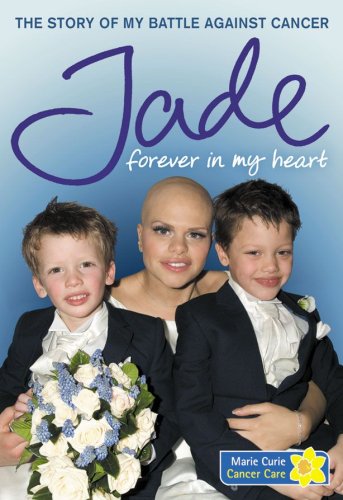
27 year old Jade Goody, British Big Brother reality-TV celeb, didn’t face that sort of choice - she had a ghost writer.  However other books like Randy Pausch’s ”The Last Lecture” (below) would have meant a much higher degree of personal involvement.

Before dying in a hail of bullets from JG fans (my autographed Michael Jackson poster is on the wall just left of my framed Princess Diana photo) there’s no question that having a terminal illness would concentrate your mind on the things that are important in life.

It’s easy to see the appeal of writing about your moment of clarity:

I’m dying, and these cretins around me are worrying about how to set up the digital video recorder to tape the next episode of ’Heroes’.  So listen, here’s what the view looks like from the edge of the cliff –

The consequences for the author’s family might be not quite as intended (a grandparent I know caused consternation by writing a children’s novel shortly before dying with various thinly veiled portraits of family members and even mixed generations in the same story) but it’s still a family legacy of sorts.

Death is interesting when it’s not someone close

Admit it or not, most people quite like to participate in a tragedy (if not personal) much as we like to watch a good crime TV episode, and deep down maybe even hope that it will give us a bit more perspective on own lives, or at least make them look better… (my own explanation for the implausible appeal of horror movies).

Yet despite the fact that we’ve heard the phrases ‘live each day as if it was your last’  or ‘life is a terminal illness‘ 1.1 million times it’s hard to focus on the important things.  Even where you’ve had a life-threatening illness,  accident or just plain high-risk moment, the effect wears off rapidly within a year or so and you are back to obsessing about whether you are getting the best interest rate on your term deposits.

The things that you really want get deferred (a baby-boomer I know actually plans to start writing their novel at 65  – a lot harder to do the mental rewiring necessary at that age).

And, let’s face it, it is genuinely important to generate the cashflow to support a family, or save the income to support the 20 to 30 years of old age that most of us face. We can’t spend all our time sculpting.

Our own death: not something to think about?

Thinking and reading about The (better) Randy Pausch written while dying bookother (interesting) people dying like Randy Pausch might well be ok, but thinking about your own death is surely maudlin/depressing/unhealthy and perhaps downright self-indulgent?

After all, a positive mental attitude even makes you live longer?

We…ll (as Samantha on ‘Bewitched’ used to say) maybe a little thought about death could be useful at times.

For example it’s worth being aware that if you’re going to work 6-7 days a week to put together a pile of cash, it is quite possible you won’t be around to spend it.

The age you’re going to die

How possible?

Well there are some rather emphemistically named ‘Life Tables’ (because they’re more like ‘Death Tables’) which give you an idea of what the death risk might really be for you as an individual (see below for 2003 figures for the USA).

For example,  more than 1 in 10 of our aforementioned 65-year-old novelist’s classmates will already be dead by the time he puts pen to paper, and he personally has around a 6% chance of dying between the ages of 60 and 65 alone.

These are quite appreciable risks:  your peers may well do riskier stuff than you do but the fact that 1 in 20 will be dead before 50 bears thinking about. This is not like taking 20 bets on sharemarket stocks and knowing one will be a big loser - this is a bet you don’t come back from. 

Age range Proportion of your classmates dying over age range Cumulative proportion of your classmates dead at age range Rough age you’ll die (median of age range+expected years to live)
1-5

0.12%

1%

80.4

5-10

0.07%

1%

81.5

10-15

0.09%

1%

81.5

15-20

0.33%

1%

81.6

20-25

0.49%

1%

81.8

25-30

0.49%

2%

82.1

30-35

0.56%

2%

82.3

35-40

0.74%

3%

82.6

40-45

1.16%

4%

82.9

45-50

1.75%

5%

83.3

50-55

2.58%

6%

83.9

55-60

3.63%

9%

84.7

60-65

5.58%

12%

85.6

65-70

8.21%

17%

86.7

70-75

12.50%

24%

88.2

75-80

18.87%

33%

90

80-85

28.89%

46%

92.2

85-90

42.02%

62%

94.8

Derived from: http://www.disastercenter.com/cdc/LifeTable2005.html

As you can see from the table the risk accelerates somewhat from around 55 onwards.

Still feel there’s definitely going to be time later to do the things you want to do now?

The risk of living till you’re really old

A risk also worth thinking about is the risk that you don’t die but end up incapacitated, uncomfortable, or off-your-tree for a considerable period in old age (yeah possibly you can’t appreciate the distinction then) and if you’re 80 to 85, realizing that half your friends won’t attend your funeral (unless it’s in the same cemetery because you’ve already been to theirs). 

There’s a nice little ‘how long will I live’ calculator at Penn U where you can plug in your own characteristics like gender, diet, where you live,  stress, travel etc and be given an approximate year of death for your personal circumstances if you want to delve into personal risk factors (medical information on the internet is ranked inappropriately but that’s another story).

What you might find most scary using the calculator is not when you’ll die (assuming any reader of this sort of article is a risk-averse individual who tests the depth of a puddle before stepping in it) but the odds of living too long… For example, my personal estimate includes a 25% probability that I will live to 95 or longer (the prospect of funding 30 years of retirement … great!). 

Although it’s difficult to buy the argument that with increasing life expectancy we’ll never die (because life expectancy will increase at the same rate we age) the trend is your enemy here as the CDC notes, “from 1900 through 2004, life expectancy at birth increased from 46 to 75 years for men and from 48 to 80 years for women.”

Unlike the risk of premature death it’s difficult to know what to do about living past your sell-by date.  It’s all very well to think that an extra bottle of pills will help you out when the time comes, but even if you’ve got the means and intellectual capacity to carry it out, the will to live is pretty strong even when the quality of life is crap.

Posted under Cliche watch, Self doubt

This post was written by mike on July 13, 2009

Tags: , ,

Australia, the movie: by way of Pearl Harbour, John Wayne, the Australian Tourism Commission (and Baz Luhrmann)

I’m writing this hiding in the bathroom from my partner, with whom I’ve just seen Australia, the movie. She liked it and thinks I need to disclose that I don’t like mangoes, vegemite and other Australian sacred objects.

This film had everything:

  • an aborginal noting in the end that Australia was for for ‘all of us’ (white and black) with a footnote about an apology in 2008 for the stolen generation
  • a lead male character referred to only through the film as ‘the drover’ (gosh do you think  they’re arguing that he is the quintessential embodiment of those heroes of the open plains) – I nearly choked on my popcorn when as Hugh and Co dragged the children away from ‘Mission Island’ where they had been trapped by the evil clergy the heroic aboriginal brother in law tells him “Drover you’ve got to take that mob of children home…” 
  • continual ersatz symbolism throughout the film targeting American movie-goers (let’s face it you’re not going to earn back your $150m+ budget just from Australians): the ‘Wizard of Oz’ theme tune,  John Wayne style river crossings, and let’s not forget homage to Pearl Harbour in the climactic bombing of Darwin by the evil Japanese
  • slo-mo shots of Hugh Jackman soaping his torso under the stars and rather cruel extended closeups of Nicole Kidman (tough on the 40+ generation)

All of this rendered in CGI-led hyper-realism and panoramic landscapes oddly reminiscent of Northern Territory tourism promotional videos (especially funny if you know the Kimberly region as they leaped from tourist spot to tourist spot).

Finally, just in case the above seems rather unbalanced, verging on un-patriotic, Nullah the kid was good and the score was good too.

Another one, where you suspect that there is one guy behind it, who has become so successful that nobody around them is being honest any longer.

Geez Baz, you needed an editor: 4 individuals in the script credits were clearly not enough.

Posted under Cliche watch

This post was written by mike on December 3, 2008

Tags: , , , ,