Pros and cons of the celebrity cancer confessional

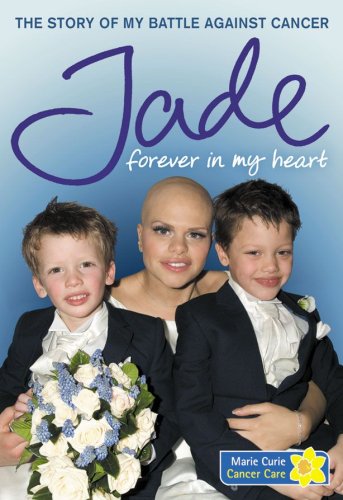
The writing about dying businessJade Goody - Big Brother reality-TV celeb - not recommended reading
It’s hard to be a fan of the celebrity cancer confessional.

 Apart from the similarity to watching a sports match where you  know the likely outcome, and that disease should at least be the great social leveller, you also wonder about priorities i.e. how would you like to spend your last year, doing stuff with people who are important, or writing a book?

27 year old Jade Goody, British Big Brother reality-TV celeb, didn’t face that sort of choice - she had a ghost writer.  However other books like Randy Pausch’s ”The Last Lecture” (below) would have meant a much higher degree of personal involvement.

Before dying in a hail of bullets from JG fans (my autographed Michael Jackson poster is on the wall just left of my framed Princess Diana photo) there’s no question that having a terminal illness would concentrate your mind on the things that are important in life.

It’s easy to see the appeal of writing about your moment of clarity:

I’m dying, and these cretins around me are worrying about how to set up the digital video recorder to tape the next episode of ’Heroes’.  So listen, here’s what the view looks like from the edge of the cliff –

The consequences for the author’s family might be not quite as intended (a grandparent I know caused consternation by writing a children’s novel shortly before dying with various thinly veiled portraits of family members and even mixed generations in the same story) but it’s still a family legacy of sorts.

Death is interesting when it’s not someone close

Admit it or not, most people quite like to participate in a tragedy (if not personal) much as we like to watch a good crime TV episode, and deep down maybe even hope that it will give us a bit more perspective on own lives, or at least make them look better… (my own explanation for the implausible appeal of horror movies).

Yet despite the fact that we’ve heard the phrases ‘live each day as if it was your last’  or ‘life is a terminal illness‘ 1.1 million times it’s hard to focus on the important things.  Even where you’ve had a life-threatening illness,  accident or just plain high-risk moment, the effect wears off rapidly within a year or so and you are back to obsessing about whether you are getting the best interest rate on your term deposits.

The things that you really want get deferred (a baby-boomer I know actually plans to start writing their novel at 65  – a lot harder to do the mental rewiring necessary at that age).

And, let’s face it, it is genuinely important to generate the cashflow to support a family, or save the income to support the 20 to 30 years of old age that most of us face. We can’t spend all our time sculpting.

Our own death: not something to think about?

Thinking and reading about The (better) Randy Pausch written while dying bookother (interesting) people dying like Randy Pausch might well be ok, but thinking about your own death is surely maudlin/depressing/unhealthy and perhaps downright self-indulgent?

After all, a positive mental attitude even makes you live longer?

We…ll (as Samantha on ‘Bewitched’ used to say) maybe a little thought about death could be useful at times.

For example it’s worth being aware that if you’re going to work 6-7 days a week to put together a pile of cash, it is quite possible you won’t be around to spend it.

The age you’re going to die

How possible?

Well there are some rather emphemistically named ‘Life Tables’ (because they’re more like ‘Death Tables’) which give you an idea of what the death risk might really be for you as an individual (see below for 2003 figures for the USA).

For example,  more than 1 in 10 of our aforementioned 65-year-old novelist’s classmates will already be dead by the time he puts pen to paper, and he personally has around a 6% chance of dying between the ages of 60 and 65 alone.

These are quite appreciable risks:  your peers may well do riskier stuff than you do but the fact that 1 in 20 will be dead before 50 bears thinking about. This is not like taking 20 bets on sharemarket stocks and knowing one will be a big loser - this is a bet you don’t come back from. 

Age range Proportion of your classmates dying over age range Cumulative proportion of your classmates dead at age range Rough age you’ll die (median of age range+expected years to live)
1-5

0.12%

1%

80.4

5-10

0.07%

1%

81.5

10-15

0.09%

1%

81.5

15-20

0.33%

1%

81.6

20-25

0.49%

1%

81.8

25-30

0.49%

2%

82.1

30-35

0.56%

2%

82.3

35-40

0.74%

3%

82.6

40-45

1.16%

4%

82.9

45-50

1.75%

5%

83.3

50-55

2.58%

6%

83.9

55-60

3.63%

9%

84.7

60-65

5.58%

12%

85.6

65-70

8.21%

17%

86.7

70-75

12.50%

24%

88.2

75-80

18.87%

33%

90

80-85

28.89%

46%

92.2

85-90

42.02%

62%

94.8

Derived from: http://www.disastercenter.com/cdc/LifeTable2005.html

As you can see from the table the risk accelerates somewhat from around 55 onwards.

Still feel there’s definitely going to be time later to do the things you want to do now?

The risk of living till you’re really old

A risk also worth thinking about is the risk that you don’t die but end up incapacitated, uncomfortable, or off-your-tree for a considerable period in old age (yeah possibly you can’t appreciate the distinction then) and if you’re 80 to 85, realizing that half your friends won’t attend your funeral (unless it’s in the same cemetery because you’ve already been to theirs). 

There’s a nice little ‘how long will I live’ calculator at Penn U where you can plug in your own characteristics like gender, diet, where you live,  stress, travel etc and be given an approximate year of death for your personal circumstances if you want to delve into personal risk factors (medical information on the internet is ranked inappropriately but that’s another story).

What you might find most scary using the calculator is not when you’ll die (assuming any reader of this sort of article is a risk-averse individual who tests the depth of a puddle before stepping in it) but the odds of living too long… For example, my personal estimate includes a 25% probability that I will live to 95 or longer (the prospect of funding 30 years of retirement … great!). 

Although it’s difficult to buy the argument that with increasing life expectancy we’ll never die (because life expectancy will increase at the same rate we age) the trend is your enemy here as the CDC notes, “from 1900 through 2004, life expectancy at birth increased from 46 to 75 years for men and from 48 to 80 years for women.”

Unlike the risk of premature death it’s difficult to know what to do about living past your sell-by date.  It’s all very well to think that an extra bottle of pills will help you out when the time comes, but even if you’ve got the means and intellectual capacity to carry it out, the will to live is pretty strong even when the quality of life is crap.

Posted under Cliche watch, Self doubt

This post was written by mike on July 13, 2009

Tags: , ,

Dangerous health risks lurking on the internet

Even as someone who started working on the web 12 years ago I am still awed by the ripples spreading out from simple full text search.Photo by Zemlinki! from Flickr licensed using Creative Commons

Dinner party argument about an obscure fact? Google it. Wish there was a piece of software written by someone that organised your email just-so.. Google it. How much has the Korean market risen over the last couple of years? Google it. Want to find a phone number for restaurant? Yep, Google it.

Economists talk about search costs in the sense of the preamble to a buying decision made by a consumer and although some people have questioned whether web search engines = reduced consumer search costs my personal analysis is that I am now able to find information that 10 years ago I wouldn’t have been able to without investing considerably more time and money. 

But what about the quality of that information? In a discussion with a publishing friend a couple of weeks ago she noted that the problem with distinguishing ‘good’ information on the web, was that Google didn’t tell you what was ‘good’ quality information and what was a poor quality information.

Of course, this is not entirely true, as Google’s search results algorithm takes into account the number of people on other websites out there on the web who link to your website, and considers that each outgoing link to your site as a ’vote’ for the quality of your site (PageRank). All other things being equal, the more incoming links, the closer your website to the top of the search results.

However what if that (perhaps even well-linked to) information out there on the web is just plain wrong?

It’s staggering what well meaning and often highly intelligent people believe just by virtue of having found it on the internet (or having received something by email from a friend ‘check it out’ by simply Googling it to obtain confirmation) and then believe it is true.

Here are three important things (see links for details) you need to know right now about dangerous cancer health risks inside your home:

  1. having a wifi network in your home increases your chance of cancer and particularly your kids’ cancer risk (if they’ve got one at school speak to your parent teacher association – it should be ripped out right now)
  2. using underarm deoderant increases your chances of breast cancer
  3. re-using plastic mineral water bottles gives you cancer as well

There are some giveaways when you read these articles as to their real validity, for instance often the articles concerned will use wording that should set off alarm bells, like (in the BBC article above on wifi networks) “there is insufficient long-term evidence to demonstrate whether such networks are safe”.

Think about this for a minute … what exactly would such evidence look like…. hmmm…. perhaps use of wireless networks for 30 or so years by children with no statistically signficant difference in cancer incidence for them versus non-wifi exposed children? How exactly do you prove something is safe in that sort of context - well I guess there’s 50 years or so experience of use of radio transmitters appearing to be pretty safe but does that ‘prove’ it always safe?  Fundamentally I suspect you can’t prove something is safe by this sort of formulation - you can only ‘prove’ something is unsafe.

There is other authoritative documentation on the the web which might seem to undermine the thrust of this BBC article (for example the UK Health Protection Agency here) but it doesn’t necessarily appear at the top of the search results.

For all Google’s comprehensiveness and PageRank the fact that (as of writing) the 4th result for the phrase “underarm deodorant breast cancer aluminium oxide” doesn’t mean that it’s true. Not all web information sources are equal. For example, the National Cancer Institute governmental site says  pretty clearly “There is no conclusive research linking the use of underarm antiperspirants or deodorants and the subsequent development of breast cancer.”

Finally, let’s try Googling “cancer re-use of plastic bottles” and as expected there at the number two result all our worst fears are realized. So what does the American Cancer Society have to say about it:

These emails are apparently based on a student’s college thesis. In fact, DEHA is not inherent in the plastic used to make these bottles, and even if it was the U.S. Environmental Protection Agency (EPA) says DEHA “cannot reasonably be anticipated to cause cancer” 

This last example is also interesting as the myth appeared to be based on a student’s college thesis, which raises the key point that somewhere in the world you can always find a scientist (sometimes retired) who is prepared by reason of fame, fortune or other more positive reasons, to support your claim. 

That doesn’t make it true.

And in effect this very article today is merely perpetuating the three myths above.

Why? Because in spite of the thrust of the paragraphs above, this article links to three websites on the web where the myths are given credence. Because of the links above Google has just received further evidence that perhaps these myths have validity and will rank them higher in search results!

And if you receive an email shortly from a trusted friend claiming that Bill Gates will pay you to forward it, my guess is that somewhere you can find supporting evidence for this on the web.

Posted under Unanswerable questions

This post was written by mike on September 29, 2008

Tags: ,