You’re not just a pretty face

Do you need glasses or just facial recognition genes? - photo by nonick on Flickr licensed under Creative CommonsI think I lack a facial recognition gene.  Yeah, I know nobody finds it easy to recognise people or remember their names. This is not what I’m talking about.

I can remember people’s names, I just can’t tell whether I’ve met them or not.  My recognition techniques therefore include getting into inane conversations with them and hoping that by talking about nothing for a while something they say rings a bell.

My lack of facial recognition skills is highlighted in social situations because I happen to look slightly odd and am therefore relatively easy to remember. Not odd-so-you-want-to-sidle-away-and-put-a-hand-loosely-in-the-vicinity-of-your-imaginary-sidearm-odd,  just odd enough so that most people remember me.  All my life I’ve wanted to blend well into a crowd but it was not to be.

Hanging around with me on a more permanent basis can be even more trying.  My partner claims that going to a movie is a seriously frustrating experience.

“So is that guy in the blue shirt the same guy that was in bed with heroine earlier?”

“Ssshhh!”

“Ok, well just tell me if I’m wrong?”

“Shut up!”

Yep, a change of clothing can be a real problem. If a shirt falls in the forest, and as a movie-goer I do not observe it, is it the same person?

Thank god for the conservatism of studio producers. If they didn’t insist on bankable stars like Julia Roberts etc I would be in real trouble – all you would-be actors out there, your enemy is not moneymen bankrolling films who insist on a bankable star, your real enemy is the facial-recognition challenged (FRCs).

And as for cast-of-thousands epics: forget it! I might just be able to identify Russell Crowe in ‘Gladiator’ (let’s face it he’s fairly distinctively ugly) but anyone with a bit part in it was toast.

To simulate the FRC experience for yourself try walking into a supermarket in an ethnic neighborhood (whatever you consider ethnic) or just take a look at an online crowd scene for some ethnic group different for your own. Now imagine you feel like that pretty much all of the time.

Oh you guys all look so SIMILAR - photo by notsogoodphotography on Flickr licensed under Creative Commons

If your current significant other doesn’t seem to like going to parties with you, but is always up for a meeting in a bar, it might not be that she’s an alcoholic, she just might be an FRC sufferer and prefer one-on-one dating to group dates.

If this is all beginning to sound depressingly familiar from your own experience you might be relieved to hear that there is evidence that facial recognition skills depend mostly on your genes and not your own memory issues. Admittedly it’ll probably turn out in a 100 years time, when we understand genetics better, that everything is genetic, launching a whole new century of speculation over free will, identity etc, but by then we’ll probably be manipulating the same genes at will anyway.

All is not lost however for FRC sufferers amongst us: we now have social media to level the playing field.

As social interactions become more and more electronic with the aid of Twitter, Facebook, online dating personals sites and TellMeAboutYourDaySoICanSellProductsToYouAndYourFriends.com, you can interact with people without even having to worry about their faces. I seem to have no trouble with the cartoonified faces cropping up these days in Twitter for example.

My helpful tip for FRC sufferers is therefore this: avoid going out socially for the next six months or so, get online, start texting like Gen Y, and find a decent home grocery delivery service. Everything will be fine.

Also, look out for my new iPhone augmented reality application, ‘Who The F**k Is That?’, where you point your iPhone camera subtly at people you don’t recognise and it looks them up (when I can get it approved by Apple under their app developer Terms and Conditions some time over the next decade).

P.S. For more personal relationship therapy for those challenged in the social skills department see my upcoming article ‘Why tall people in a crowded room suffer a hearing disadvantage but they’re not really deaf or stupid.’

Posted under Hate pets, Self doubt

This post was written by mike on May 9, 2010

Tags: ,

Pros and cons of the celebrity cancer confessional

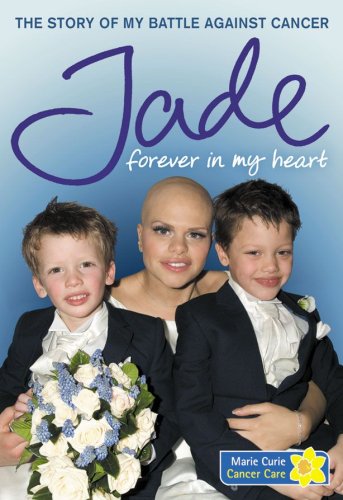
The writing about dying businessJade Goody - Big Brother reality-TV celeb - not recommended reading

It’s hard to be a fan of the celebrity cancer confessional.

 Apart from the similarity to watching a sports match where you  know the likely outcome, and that disease should at least be the great social leveller, you also wonder about priorities i.e. how would you like to spend your last year, doing stuff with people who are important, or writing a book?

27 year old Jade Goody, British Big Brother reality-TV celeb, didn’t face that sort of choice - she had a ghost writer.  However other books like Randy Pausch’s ”The Last Lecture” (below) would have meant a much higher degree of personal involvement.

Before dying in a hail of bullets from JG fans (my autographed Michael Jackson poster is on the wall just left of my framed Princess Diana photo) there’s no question that having a terminal illness would concentrate your mind on the things that are important in life.

It’s easy to see the appeal of writing about your moment of clarity:

I’m dying, and these cretins around me are worrying about how to set up the digital video recorder to tape the next episode of ’Heroes’.  So listen, here’s what the view looks like from the edge of the cliff –

The consequences for the author’s family might be not quite as intended (a grandparent I know caused consternation by writing a children’s novel shortly before dying with various thinly veiled portraits of family members and even mixed generations in the same story) but it’s still a family legacy of sorts.

Death is interesting when it’s not someone close

Admit it or not, most people quite like to participate in a tragedy (if not personal) much as we like to watch a good crime TV episode, and deep down maybe even hope that it will give us a bit more perspective on own lives, or at least make them look better… (my own explanation for the implausible appeal of horror movies).

Yet despite the fact that we’ve heard the phrases ‘live each day as if it was your last’  or ‘life is a terminal illness‘ 1.1 million times it’s hard to focus on the important things.  Even where you’ve had a life-threatening illness,  accident or just plain high-risk moment, the effect wears off rapidly within a year or so and you are back to obsessing about whether you are getting the best interest rate on your term deposits.

The things that you really want get deferred (a baby-boomer I know actually plans to start writing their novel at 65  – a lot harder to do the mental rewiring necessary at that age).

And, let’s face it, it is genuinely important to generate the cashflow to support a family, or save the income to support the 20 to 30 years of old age that most of us face. We can’t spend all our time sculpting.

Our own death: not something to think about?

Thinking and reading about The (better) Randy Pausch written while dying bookother (interesting) people dying like Randy Pausch might well be ok, but thinking about your own death is surely maudlin/depressing/unhealthy and perhaps downright self-indulgent?

After all, a positive mental attitude even makes you live longer?

We…ll (as Samantha on ‘Bewitched’ used to say) maybe a little thought about death could be useful at times.

For example it’s worth being aware that if you’re going to work 6-7 days a week to put together a pile of cash, it is quite possible you won’t be around to spend it.

The age you’re going to die

How possible?

Well there are some rather emphemistically named ‘Life Tables’ (because they’re more like ‘Death Tables’) which give you an idea of what the death risk might really be for you as an individual (see below for 2003 figures for the USA).

For example,  more than 1 in 10 of our aforementioned 65-year-old novelist’s classmates will already be dead by the time he puts pen to paper, and he personally has around a 6% chance of dying between the ages of 60 and 65 alone.

These are quite appreciable risks:  your peers may well do riskier stuff than you do but the fact that 1 in 20 will be dead before 50 bears thinking about. This is not like taking 20 bets on sharemarket stocks and knowing one will be a big loser - this is a bet you don’t come back from. 

Age range Proportion of your classmates dying over age range Cumulative proportion of your classmates dead at age range Rough age you’ll die (median of age range+expected years to live)
1-5

0.12%

1%

80.4

5-10

0.07%

1%

81.5

10-15

0.09%

1%

81.5

15-20

0.33%

1%

81.6

20-25

0.49%

1%

81.8

25-30

0.49%

2%

82.1

30-35

0.56%

2%

82.3

35-40

0.74%

3%

82.6

40-45

1.16%

4%

82.9

45-50

1.75%

5%

83.3

50-55

2.58%

6%

83.9

55-60

3.63%

9%

84.7

60-65

5.58%

12%

85.6

65-70

8.21%

17%

86.7

70-75

12.50%

24%

88.2

75-80

18.87%

33%

90

80-85

28.89%

46%

92.2

85-90

42.02%

62%

94.8

Derived from: http://www.disastercenter.com/cdc/LifeTable2005.html

As you can see from the table the risk accelerates somewhat from around 55 onwards.

Still feel there’s definitely going to be time later to do the things you want to do now?

The risk of living till you’re really old

A risk also worth thinking about is the risk that you don’t die but end up incapacitated, uncomfortable, or off-your-tree for a considerable period in old age (yeah possibly you can’t appreciate the distinction then) and if you’re 80 to 85, realizing that half your friends won’t attend your funeral (unless it’s in the same cemetery because you’ve already been to theirs). 

There’s a nice little ‘how long will I live’ calculator at Penn U where you can plug in your own characteristics like gender, diet, where you live,  stress, travel etc and be given an approximate year of death for your personal circumstances if you want to delve into personal risk factors (medical information on the internet is ranked inappropriately but that’s another story).

What you might find most scary using the calculator is not when you’ll die (assuming any reader of this sort of article is a risk-averse individual who tests the depth of a puddle before stepping in it) but the odds of living too long… For example, my personal estimate includes a 25% probability that I will live to 95 or longer (the prospect of funding 30 years of retirement … great!). 

Although it’s difficult to buy the argument that with increasing life expectancy we’ll never die (because life expectancy will increase at the same rate we age) the trend is your enemy here as the CDC notes, “from 1900 through 2004, life expectancy at birth increased from 46 to 75 years for men and from 48 to 80 years for women.”

Unlike the risk of premature death it’s difficult to know what to do about living past your sell-by date.  It’s all very well to think that an extra bottle of pills will help you out when the time comes, but even if you’ve got the means and intellectual capacity to carry it out, the will to live is pretty strong even when the quality of life is crap.

Posted under Cliche watch, Self doubt

This post was written by mike on July 13, 2009

Tags: , ,

Baby boomers: guilt or selfishness? Leisureville and the geriatric generation

 My (late 20s) sister gets some flak about being part of generation Y. You know, that generation that has:-

 ’an expectation that there will always be a job out there and that you should be able to get to the top job of any average organisation in under 2 years.’

That sort of criticism may be a little more muted now that we are watching a synchronised world economic downturn play out and Gen Y’s adjust to a different world, but, one of the most interesting things about the criticism to me is actually what it says about the (usually) baby boomer speaker.

I am fascinated by the mindset of baby boomers (those born during the post war baby boom between 1946 and 1964) because arguably all of us afterthoughts born after ‘64, whether generation X (60s-70’s) or generation Y (80s onward), are not so different, in that we have lived lives relatively similar to our parents the boomers.

What do I mean by this?

I mean that the mindset of most kids is not a little based on the mindsets of their parents… their expectations of economic achievement, friends, and the general threat level in the world is picked up by osmosis from Mum and Dad. 

However in contrast to Gen X or Gen Y the baby boomer’s parents had an almost unimaginable mindset. Imagine you are a baby boomer, born in say 1947. Your parents, and their parents (your grandparents) saw:

  • two world wars
  • the holocaust
  • the Great Depression
  • the post war Spanish flu epidemic (which in 10 months in 1918 killed 22 to 40 million people worldwide)

My parents the boomers are arguably the guilt generation of the last 100 years. 

They must subconsciously or not spend a bit of time thinking to themselves ‘how did I deserve such an easy life when my parents had a so much harder one?’ They didn’t have to fight a war (in most places), struggle to put basic food on the table for their family through a depression, or watch swathes of people they knew die in an epidemic whose death toll was highest not amongst the elderly, but in the 15 to 40 age group. Their parents had to live through all of this stuff.

What impact might this have had – and this is not a rhetorical question – if you have a view I’d love to hear it.

Are boomers striving to prove something? Are they still expecting the sky to fall, which had fallen on their parents? Is their civic identity (their propensity to join political parties for example) a reaction to their parents who needed to stick together in their social group to survive the adversities thrown at them? Just how much of their value system is based on values that were needed to survive in the world of their parents?

And yep, if you haven’t already guessed, we all need to understand our parents.

The Case for the Prosecution: Leisureville

There is also a view that the boomers are selfish, self obsessed, and just a trifle ’up themselves’ as they say in the Antipodes.

The case is made well by Andrew Blechman in ‘Leisureville’ a sociological exploration of a couple of gated retirement villages in the US where 55+ year olds drive round in golf  carts, children are banned, and Viagra has led to a re-run of the 60s.

As an early 40s type participating in late parenthood the zero children tolerance policy is somewhat appealing; many is the time where I have had those one sided conversations with parents of young children where they spend their entire time watching their kid, make no eye contact, and wouldn’t have a clue what you’d said.

Leisureville is somehow unconvincing however if you are of a live-and-let-live disposition. As many reviewers said, if you paid your taxes all your life and that’s what you choose to do then so be it. Let’s face it for every golf obsessed retirement community like this there are a hundred that you would never wish on your nearest and dearest aged parent.

It seems no more less appealing or worthy of moral judgement than baby boomers wandering from coast to coast in their RVs or caravans as they visit parks and scattered children: if they want to do it, great.

Personally, I could not help wondering re Leisureville, “I wonder if my parents would like something like this?”

Posted under Reviews, Self doubt, Unanswerable questions

This post was written by mike on March 19, 2009

Tags: , ,

Why write another blog?

Dash across to wordpress.com and as of today you’ll find 3.9 million blogs listed. Sheesh. Makes you want to stop right there. Because that would only be a fraction of the actual blogs who want more control than Wordpress or other free services like Blogger can offer them.

Photo by bucklava from Flickr licensed under Creative Commons
Ok but there’s a little more to it than that. Reading Wordpress’s tagline “3,965,250 blogs, 124,346 new posts, 41,331,398 words today” a little division tells us that if we divided up the total posts for today (well that’s how I read the tagline …) amongst Wordpress’s total blogs then at one post per blog (yeah well nobody said this was going to be scientific) only 1 in 31 blogs has a post today.

Expect to see this very stat quoted soon as gospel truth, “recent surveys have shown that only 3% of bloggers continue their blogs”.

Oh yeah, and just in case you’re wondering, “the average blog post is 330 words”.

Pretty daunting if you’re thinking about blogging.

It’s enough to make you think that perhaps self doubt is not a characteristic of your average blogger?

Yep. Google “why write another blog” and you get just 5 results:  http://www.google.com/search?q=%22why+write+another+blog%22 I shouldn’t have asked.

So why should you (or I) keep going? Well I guess for only 2 reasons:

  1. to mangle a quote from someone (from memory it’s usually George Bernard Shaw) ‘only paint or write something if the not painting or not writing of it is too difficult.’ Try everything else! And then if you still feel you have to (sigh), go ahead.
  2. this is THE medium for conversation. If you’re the kind of person who is as interested in questions as answers this is your medium. If you just want to give other people your opinion be a columnist, a TV host, or dinner party prima donna. 

Posted under Self doubt

This post was written by mike on August 31, 2008

Tags: ,