The web escapes the computer screen: what the E-reader will do for unpublished information on the web

The next information wave - Photo by mikebaird from Flickr licensed under Creative Commons

The next information wave

It’s easy to hate the most over-used phrases used to describe the web age – paradigm shift, knowledge revolution, Web 2.0 etc. 

But hey we’ve all faced the tyranny of an empty page – it’s tough out there. And faced with amazing changes to how we locate information represented by Google and the other search engines it’s easy to reach for the bottle of superlatives. 

Even the growth of email has meant a phenomenal change to the way we consume and create information in the last 15 years as documents and comments flow back and forth in minutes that used to take faxes, printers, and letters hours or days. 

Despite all these examples of card-carrying “gee whiz”  moments however it looks like we are just about to be swept up in another wave. 

We are just starting to consume knowledge in another way which may result in an equally dramatic lifestyle change when compared to the growth of search engines, or the early days of the web itself. 

Amazon's Kindle Reading Device - the A4 size DXThe on-rushing wave is the e-book (or more properly the ‘E-Reader’), with an estimated 10 million being sold by the end of this year just in the US alone and dozens of different E-Readers in the works from different companies emerging in the next 12 months – with a combined marketing budget in the hundreds of millions that will make the recent Apple iPad launch look like a hiccup. 

On the surface of it is this just another example of hyperbolic silliness? Because isn’t the E-Reader just another way to consume books that we’re already reading in hardcopy anyway, and as many have pointed out there are a lot of advantages of traditional hardcopy over the electronic alternative?Illegible computer screen text - photo by Naufragio on Flickr licensed under Creative Commons 

What is interesting about E-Readers is not the ‘E-book’ part at all. Instead E-Readers are going to very rapidly reshape how we consume information on the web. This is not about a ‘new device’ it’s about a new way to consume information, because as is somewhat obvious most of the information on the web is just not available in hardcopy form at all. And that really matters. 

Backlit screen reading is hard to do (sorry Apple I know you’re trying with the iPad). It’s hard on your eyes,  it’s not very portable (try reading a laptop with your feet up), and in this information-packed age unless you’re looking at a huge screen it is hard to skim read and quickly identify the key points in screen-based information. 

This has lead to an emphasis on other aspects of screen-based information that compensate for these drawbacks of the web on a computer screen by adding new functionality: dense hypertext links to make cross referencing easy, the ability to comment and interact with authors as represented by blogs, the ability to locate and reassemble information in many different ways as represented by search engines, and in most journalism courses a recognition that writing for the web requires a specific style (admonitions to not write more than two sentence paras etc). 

The RSS button - freedom from the screen? Photo by HiMY SYeD / photopia on Flickr licensed under Creative CommonsBut the E-Reader is changing that (read “Customized newspapers on e-books: Calibre cross-platform e-book subscription management” to see how you can subscribe to websites out there on the web on your E-Reader, via their RSS feeds,  just like you can subscribe to a podcast on iTunes). 

What happens when everything from the web is as portable and easy to read as paper? 

It’s not JUST the E-Reader: the way this is going to turn our information-consuming lives upside down is driven by a groundswell of the growth of machine-readable info feeds on sites represented by Really Simple Syndication, and emerging platforms like Calibre which enable you ’subscribe’ to any website on any E-Reader – for FREE. 

The E-book just happens to be the final crest of the wave which is about to sweep away already undermined sections of the publishing industry. 

Still not convinced? 

The only thing worse than a ‘paradigm’ shift is an attempt to predict the future so here goes with a few near-term predictions: 

  1. the world of journalism is about to get vastly more competitive – journalists in a newspaper will be competing with bloggers with more specialist knowledge who previously had limited circulation because you couldn’t purchase your average blog conveniently on a newstand or read it on the way to work on the train. The blogger is providing the information for free.
  2. How do you find the best? Photo by Diabolic Preacher on Flickr - licensed under Creative Commonsintermediaries that seek out big stories will get more important in their own verticals (wherever those stories are) whether they are using algorithms like Google or whether they are using human curated approaches like ‘The Week’, or social media mechanisms like Stumbleupon or Digg. Try and find for example, amongst the 100m+ blogs out there which are the most entertaining ones? To some extent this question was irrelevant  if those blogs didn’t get read – but not any more.
  3. new ways of consuming stories will arise – for instance ‘collaborative reading’. On my Kindle or Sony Reader or iPad or whatever why should I not be able to view annotations on a text by my colleagues, or classmates, or friends?
  4. we’re not talking individual wikis – we’re talking wiki world – why buy a ‘How To’ manual for  your motorcycle when there is a completely portable version?
  5. traditional publishers who are congratulating themselves on being web savvy like the New York Times or Guardian are going to come under even more pressure because E-Readers in many cases will have the effect of destroying ad revenue and their ability to really track readership. With the aid of software on an E-Reader like Calibre this is the equivalent of Tivo for the publishing world: in your Kindle DX via Calibre no javascript is active (so Google Analytics aint going to know you’ve read the story) all it knows is that someone downloaded their RSS feed (not which particular stories were read).  And fancy ads are not going to come across because people writing recipes to extract your content with Calibre simply don’t want them.  Even if you instituted counter-measures by embedding an ad image joined with a story image, it’s almost the equivalent of going back to the flat ad serving done in newspapers. Free at a blog near you - photo from Flickr by Rainbow Project licensed under Creative Commons
  6. even the acknowledged guru of the web commerce world, Amazon, may be shooting themselves in the foot. They want you to buy e-books from them – but why? If you can read any old PDF or niche website out there on the web from the comfort of the couch? Or a million free book titles? I bought an Amazon Kindle DX and have yet to buy a book on it (but thanks Amazon anyway for paying the wireless subscription charges).
  7. if it isn’t already obvious the E-reader is going to reduce further the cost of information globally even more: expect to add value with your startup company by better locating information, or better curation, but expect an uphill road if you think it’s about unique content (Mr Murdoch take note).
  8. a bit like podcasting has broken the barriers to entry for local radio talk shows your decision is not ‘which paper do I buy in my home town’, instead it’s ‘which blogs do I want to read from the entire internet?’ Publications are becoming ‘unbundled’ and publishing deadlines paradoxically may actually become less important in the age of instant satsifaction. Why should I read some crap which some journalist stitched together at the last moment to make the Sun weekend edition when I can read a combination of bloggers who only produce pearls once a month?


Like the sound of this new world or hate it? 

Is it not going to happen at all?  

This is a blog – talk back!

Posted under Kewl

This post was written by mike on February 22, 2010

Tags: , , , , , ,

Expect not to read e-books on your e-reader when you’re buying it

Oh dear, I'm reading less books now I have an e-reader - Photo from Flickr by Aprilzosia licensed under Creative CommonsWith the aid of the public domain Calibre e-book management application, which enables you to automatically subscribe to any news website (via RSS) and the increasing prevalence of the open (non DRM) EPUB electronic book formats that you can dump Adobe Acrobat PDFs to, you may find that books are the last thing you read on your e-book.   Let’s face it, paperbacks are easily available.   Where e-books really come into their own (assuming you’ve installed Calibre)  is in pulling down content from the web (and making it comfortable to read anywhere without a computer), content you normally cannot get in hardcopy unless you want to run your laser printer overtime.   Documents and news content like:  

  • those 140 page Annual Reports you have to read occasionally
  • various frivolous and not-so-frivolous blogs that you’d love to keep up with
  • mainstream news sites like the New York Times or the Economist where most of the major stories are actually carried for free online
  • niche news sites you’d like to be able to browse occasionally
  • 30-40 page PDFs that you have to read for work

If this sort of content appeals to you then it has definite implications for what sort of e-reader / e-book you buy.   For example, the following e-book features bear watching if you expect to be reading other things aside from books:  

  • screen size: a lot of news websites and large PDFs contain tables and images. Unlike standard text, tables become meaningless when you can’t see the row labels.  You need an e-book with a 10 inch screen to handle this type of A4 content to be able read effectively, but  most e-books come in significantly smaller sizes. Screen size is measured diagonally so an average size e-book with a 6″ screen actually has a screen width of around 3 and a half inches … you won’t see an A4 width table in that – you really need at least a 5 inch wide screen (which roughly equates to a 10″ e-book screen size).
  • battery life: as effectively a substitute printer you need a long battery life. You aren’t just going to be picking up your e-book as you sit back in bed at the end of an evening . Battery-draining features like wireless connectivity or colour LCD displays such as the new iPad provides need to be weighed up against battery life.
  • page-refresh rate: on the Sony PRS-505 page refresh rate is about a second. This is probably the maximum tolerable if you are going to be reading a lot of content. Make sure the page refresh rate is faster than a second.
  • data charges: if you’re going to avail yourself of all this valuable free content (if that’s not an oxymoron) do you really want to pay ongoing 3G charges for your reader? When you switch your machine on you will have dozens of publications to choose from all continually refreshed daily automatically by just plugging your e-book into your PC.  A current (or in the case of Amazon ‘implied’) 3G mobile data charge just doesn’t seem necessary.  Assuming you have a smartphone if you really want time-sensitive web content you can always use that.
  • rich media support: closely related to the above issue, a 3G connection where you pay volume-related data charges could turn out to be quite expensive if your e-book supports rich media like video (for example the Apple iPad). Many of the news sites you are likely to use contain rich media (or in the case of blogs badly optimized large images) and you could even find that you’re paying to watch rich media ads!

At least at the moment your choice of e-readers that fit these criteria is pretty limited (a nice comparision table, from which the simplified table below is derived, can be found on the MobileRead website).  The iRex Digital Reader probably claims the high ground with a 10 inch display but has a notoriously short battery life and at over $800 is quite expensive. The Kindle DX at 9.7 inches looks better price-wise and it’s claimed it will run for 2 weeks with wireless off – but it seems likely that The 9.7" Kindle DX from AmazonAmazon will impose some sort of data charge as their Terms and Conditions state:  

“You may be charged a fee for wireless connectivity for your use of other wireless services on your Device, such as Web browsing and downloading of personal files, should you elect to use those services. We will maintain a list of current fees for such services in the Kindle Store. Amazon reserves the right to discontinue wireless connectivity at any time or to otherwise change the terms for wireless connectivity at any time, including, but not limited to (a) limiting the number and size of data files that may be transferred using wireless connectivity and (b) changing the amount and terms applicable for wireless connectivity charges.”  

If you need an e-book now (and if information you read is a key part of your job it’s worth  it!)  then probably the Kindle DX is the only option (and at the moment anyway the data charges are not an issue because you can leave wireless switched off and there is no annual charge imposed by Amazon).   However if you’re prepared to watch and wait, there are other large-screen devices emerging – devices and their estimated release dates below (see the MobileRead site for more):

Brand HanLin eBook iRex Amazon Kindle QUE Skiff enTourage Systems
Model A9 (unreleased) Digital Reader 1000 Kindle DX QUE proReader (pre-order) Skiff Reader enTourage eDGe (unreleased)
Display Size 9″ 10.2″ 9.7″ 10.5″ 11.5″ 9.7″
Battery Life ? 10 hrs with EVDO: “4 days”, without: “up to two weeks” “measured in days not hours” One week 16+ hrs
Other Interfaces USB 2.0 (charging), headphone, WiFi 802.11g, USB 2.0 (charging); 1000SW only: WiFi 802.11b/g and Bluetooth USB 2.0, headphone, EVDO/CDMA USB 2.0 (charging), Bluetooth, WiFi 802.11g, 3G (US: AT&T) USB 2.0 (charging), headphone, WiFi 802.11g, 3G (US: Sprint) 2 x USB, headphone, WiFi 802.11b/g, Bluetooth, 3G (optional), 1.3 Megapixel camera, internal microphone and speakers
Price US$??? / €350 US$859 US$489 / €n.a. US$799 US$??? US$490
Release Date April, 2010 2008 10-Jun-09 15-Apr-10 2010 Feb-10

Posted under Reviews

This post was written by mike on January 28, 2010

Tags: , , ,

Customized newspapers on e-books: Calibre cross-platform e-book subscription management

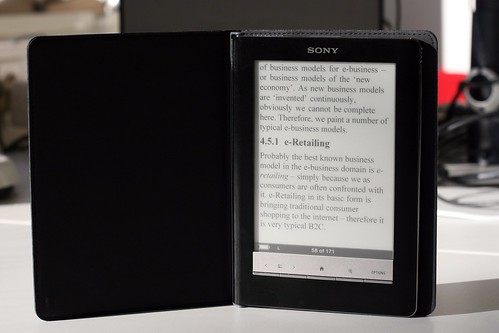
Sony E Book showing the crispness of the e-ink display with no retouching - PRS-505 perfectly adequate as customised newspaper platform - photo by egon on Flickr licensed under Creative CommonsAmidst the turmoil in the newspaper publishing market there is one big problem for journalists leaving the safe-ish harbour of their big name publications and starting to experiment out on their own (if you are still wondering why you should be doing this read this as to why your safe harbour aint safe).

It’s distributing your blog to your readers.

Distributing your blog

Talking about distribution seems kind of odd in a way. Kee-rist, this is the world wide web isn’t it? Surely there are no problems there?

Well of course there are.  The majority of the population rarely read blogs at all. Blogs aren’t exactly a core part of their reading habits.

On commercial sites the volume of RSS-sourced subscriptions and even email-subscription  page reads usually make up the minority of traffic (RSS is barely a rounding error) and the ever present big brother Google accounts for 75% of traffic.  And of course Google readers are not ‘regular’ readers are they? They just happen to be doing a search where your blog came up.

RSS news readers, while they are available in all sorts of flavours (dedicated desktop software apps and web based ones like Google News Reader), are still the province of the technorati or news junkies.

The big hope for bloggers is of course the burgeoning electronic book reader market. With estimates that Amazon has sold about 1.5m Kindles so far  and 6m new e-book readers expected to be sold in the US alone this year, e-book readers are fast becoming mainstream, but at this stage a lot of e-book readers seem just that:  mainly for buying books (ignoring the Amazon hype that they sold more electronic books on Christmas Day than real ones – what exactly did anyone expect).

We can all buy books in hardcopy – we obviously can’t get blogs that way.

Drivelry on the KindleFor bloggers the Kindle and Sony Reader were still relatively problematic as a distribution method because Amazon charged a subscription for you to subscribe to your favourite blog (imagine Dell charging you every time you downloaded a web page!) and required the blogger to sign up for the Kindle program for which Amazon generously gives you 30% of the revenue they earn.

And Sony’s reader has only just gone wireless with the ‘Reader Daily Edition’ targeted at newspapers.

Both the Sony and Kindle readers rely on an ongoing 3G connection which must be paid for somehow. The Sony PRS-900 unit (currently on back-order since they’ve sold out) for example is a minimum $15 per month.

Of particular interest for would-be bloggers wondering how they are going to get distributed to a mainstream readership is an e-book which does not require you to sign up for some sort of subscription for wireless access (a notable issue at the moment given the number of competing e-readers emerging, many of which are unlikely to exist in 5 year’s time), and being able to make a blog available all the time on the device.

Calibre

The most interesting development in this regard is not the hardware e book devices at all but public domain sofware that is emerging that will enable you to keep your e-book (whatever it is) synchronized with the bloggers you wish to follow (usually via RSS).

Finally, in following up on a concept that emerged way back in the mid 90s, you really can have a customised newspaper (for free) that is just as portable as your normal newspaper.

This missing piece in the jigsaw that gets you your customised newspaper effortlessly on your ebook today is a piece of free public domain software called Calibre, which has already been downloaded 500,000 times. Calibre is cross platform – for example it supports both Sony and Kindle readers as well as others.

Calibre: free, cross-platform blog and news management for your E Book

Calibre: free, cross-platform blog and news management for your E Book

As with podcasts, Calibre will automatically synch free RSS versions of blogs (as well as log-in versions of major publications like FT.com or the New York Times by supplying your username and password during configuration) with your e-book. All you have to do is plug in your e-book to the PC and Calibre squirts all the content across (and with the WiFi e-readers emerging like PlasticLogics it is likely you won’t even have to do that at some stage in the near future).

While the new Plastic Logic e-book for example touts about 30 news sources Calibre out of the box already supports 400 mainstream news sources for free - in multiple languages at the time of writing with more being added every day. And it is simple to add an additional news source of your own like your favourite blogs just by telling it the location of that blog’s RSS feed. Then tell Calibre when you want to synchronise (once a day at 9am for example) and you’re done!

You don’t have to wait: you can put together a customised newspaper template for yourself out of your favourite blogs today, and you can do it without paying a subscription charge with practically any e-book out there. If your e-book reader is WiFi or 3G equipped then the hyperlinks that show up in the publications that you’re reading will be active, but if you’re using say a more basic e-book like my Sony PRS-505 you are still way ahead of the non-e-book world.

PS If you use Calibre already (or after reading this article) you are reading publications where the ‘recipe’ has been written by Darko Miletic. To help him keep purchasing devices to test recipes on you can contribute here (Chip In below).

Posted under Reviews

This post was written by mike on January 17, 2010

Tags: , , ,

Write comments for (and create links to) blogs that appreciate them

Link love from Flickr by Sister72 licensed under Creative CommonsIf you are a blogger just starting out, there is a bright shiny world of poor blogging advice to be discovered.  It covers the full spectrum:

  • how (not to) build an audience for your blog,
  • how (not to) to monetize your blog, and last but not least 
  • how (not to) choose your blog topics…

At times it may look like the most successful blogs are themselves about blogging and are mainly read (and monetized) by other up and coming bloggers (yep I can see the hypocrisy warning light flashing a bright orange  on the Drivelry editorial floor).

The number of blogs is growing globally at 50% a year

It is also a highly competitive world. 

When Drivelry.com started in August 2008, Wordpress.com maintained a count of the number of blogs they hosted on their home page and it stood at 3.9 million (bear in mind that Wordpress is only one of several free hosting platforms that include Blogger and many others).

In January 2009 (6 months later) Wordpress stopped revealing this information, perhaps because they thought it would discourage newbie bloggers, or because it was information they didn’t want to make available to their competitors.  However January’s (last published) Wordpress figure of 5.2 million blogs hosted  implies a growth rate of over 2 million new blogs a year – or to put it another way that the blogging community (as represented by Wordpress.com) is growing at an annual rate of 50% … 

Although not every blog is active that is still a truckload of text being generated every day to be chewed through by search engines which typically account for 60-70% of most website’s traffic. 

Links to your blog are important: so how do you acquire them?

What makes your blog more important to the mother of all search engines (Google) apart from the text you use? 

Links to your blog, which Google regards as a proxy for your blog’s  importance, aka ‘PageRank’.

It’s at this point that we come back to the conventional wisdom about links.  

Essentially it says ‘give the A-list bloggers links and comments and they will reciprocate’ (it’s kind of like the trickle-down theory of economics).  Well it could be that Drivelry frequently verges on the obnoxious but …. we haven’t seen much trickling down yet.  This might have worked as a technique in the days when people were not so ‘link-aware’  but seems not to be the case in 2009.

The community out there is generally aware that links are valuable and that even leaving comments helps generate indexable text.  And frankly most A-list bloggers have enough of both.

If you think you can get around this by leaving a link on someone else’s blog you need to be aware that nearly all blogs implement the “no follow” directive on their comment links which tells Google to ignore the link in calculating PageRank (and this is also implemented on authoritative sites like Wikipedia).

So what’s the alternative?

From small seeds larger things grow - photo from Flickr by iChaz licensed under Creative CommonsLink to (and comment on) blogs who appreciate links and comments!

They are likely to be smaller blogs and they need to be ‘link aware’ so that ideally they will a) notice your link to them and b) allow you to make a ‘followable’ link in your comments on their blogs (it is possible to turn off the standard ‘NoFollow’ that is generated in Wordpress on links in comments).

Sounds pretty logical – so how do you find these sorts of blogs?

Well it’s actually not as hard as you might think.  Bloggers who implement ’DoFollow’ functionality on their blogs are:

  1. Obviously aware by their use of ‘DoFollow’ of the value of links
  2. Likely to be smaller as the very popular (higher PageRank) blogs tend to get targeted by spammers in comments – eventually causing these blogs to revert back to ‘NoFollow’
  3. Often advertise the fact that they are ‘DoFollow’ so that you can find them in ‘DoFollow’ directories or Google Custom Search engine instances which only return search results from Blogs that are DoFollow

Drivelry.com is itself a DoFollow blog.

DoFollow blog search engines

For example here are a couple of search engines that find text contained in ‘DoFollow’ blogs if you want to add these to your browser toolbar as additional search providers:

http://w3ec.com/dofollow/

http://atniz.com/dofollow-search-engine/

http://www.commenthunt.com/

Health warnings about the use of DoFollow blog search engines

It is worth noting three things in relation to DoFollow search engines:

  1. these search engines are not necessarily maintained by the providers out of their goodness of their hearts (in many cases they only maintain these engines so that they can use them as a data source to run search engine optimisation link generation campaigns by inserting spammy comments of their own) and,
  2. due to the abuse of  ‘DoFollow’ blogs as they become more popular, sites listed in DoFollow search engines may ‘revert’ back to NoFollow so it is often worth checking whether the blog still remains ‘DoFollow’ by doing a ‘View Source’ on their comment page
  3. blogs listed in DoFollow search engines typically moderate their comments to avoid becoming a target for spammers – if your comment says something like ‘Great post. Here’s a link to my blog ….’ it is typically going to be rejected by the blog owner as they are looking for you to add comment value with your link.

Despite the pitfalls above it is worth focusing your interactions on smaller DoFollow blogs rather than the A-listers.  Most of these people will value you linking to them and may reciprocate by doing the same, and will reward you for interacting with their posts in comments by enabling links you leave to count towards your blog’s PageRank.

If enough blogs do this it may help all of us find a way out of the cul-de-sac  that PageRank has led to where bloggers are sometimes unwilling to link to good information sources out there. A quick look at Google Trends for ‘DoFollow’ suggests there is hope here.

You may even want to think about making your own blog DoFollow!

Posted under Hate pets

This post was written by mike on August 5, 2009

Tags: , ,

Let’s hope the medium is not the message

The video that should have been an article

Lecture video on Flickr by Andrew Feinberg licensed under Creative CommonsWhat motivates people in chosing media types to publish their content? Why, for example, produce a video on a topic which would be far better expressed in print?

How do we benefit from having a talking head pushing their favourite stocks or shares in a video, complete with fleeting verbal references to the  key figures on which the whole argument rests like year-on-year increases in turnover, profits etc?

Is it just that a lot of people secretly fancy themselves in the moviemaking business or, is there some deep dark secret here that accounts for the proliferation of video in a lot of people’s sites?

For instance is it just that:

  • video is harder to copy and host so spammers are less likely to rip off your content?
  • video creates a deeper rapport with your audience?
  • you’re tapping an audience (YouTube?) that you can’t reach in another media?
  • the video is a disguised advertisement for speaking engagements?

Sure video is harder to copy but it’s also a hell of a lot harder for search engines to index… It may well be the case that in 10 years time it will be fully indexable with a speech recognition engine – well if you’ve got a 10 year plan to build an audience that’s great.

If you have the comic timing of Stephen Colbert or the beauty of Angelina Jolie  it may well make sense to produce a video, but if you don’t personally have either of these traits you’re wasting your time.

On the negative side with videos:

  •  you’ve got to be running sound (perhaps in an open plan office) to watch a video,
  • there is no way that your viewer can quickly skip to the bits that interest them (so the first time you’ve lost their attention you’ve lost them totally as they hit the stop button) and
  • you require their full attention e.g. they can’t be listening to music as they watch.

Why is it that people don’t get podcasting?

Creative Zen MP3 player by blogefl on Flickr licensed under Creative CommonsIn 2005 the hype that currently is devoted to apps like Twitter or Facebook was all about the new medium of podcasting,  hype that Drivelry signed up for at the time.

In contrast to video this really does seem to be a publishing medium that makes sense for a lot of content.

Yet very little onscreen commentary acreage is devoted to podcasting these days, and the growth of podcasting has been relatively slow with about 12% of people interviewed by the Pew research study having listened to podcasts in 2006, and 19% listening when Pew re-ran the study in 2008.

All up a very pedestrian 7% growth in podcasting usage in the 2 years (presumably Pew is unlikely to rerun the survey till 2010 albeit newer July 2009 figures suggest that growth might be accelerating somewhat).

In a sense it’s a testament to the power of advertising. As in ‘podcasts are free so there’s little incentive to push them’

You can identify popular podcasts on iTunes but it will default to popular podcasts for your country (using automatic IP address location) rather than globally, thereby undermining one of the principle benefits of podcasts: that they enable you to listen to the best radio in the world at the time of your choosing, with the most recent episodes collected for you automatically.

Podcasts make sense as a publishing medium because they enable you to:

  • target otherwise unused audience time (for instance when you are driving or on public transport)
  • they do not require your full attention (you can cook or clean whilst listening)
  • they take advantage of radio’s traditional ability to build rapport

In theory you can monetize them by using a system such as Wizzard’s.

There are absolutely superb podcasts out there from organisations like NPR, the BBC and assorted smaller producers that mean you should never have to listen to a boring radio program again (you can find a few of  Drivelry’s favourite podcasts here  if you want a random playlist you can import into iTunes).

If you know why podcasts are so under-appreciated hit the comments box below and tell us why!

Twitter as a publishing medium

It’s impossible to consider the appropriateness of publishing technology without mentioning Twitter. Photo of Twitter screens on Flickr by glenn.batuyong licensed under Creative Commons

It’s not that SMS’ing is a bad concept (think of the positives for a whole younger generation who now have to be functionally literate to socially interact) but with Twitter we have a publishing medium where the length of your story at 140 characters is dictated by a technology launched 17 years ago.  If Douglas Adams was still alive today it would form a key joke to build a novel around. 

There is not a frequent Twitter user out there who hasn’t spent hours of aggregated time trying to work out how to compress something meaningful into 140 characters and then hoping that the mishmash of bad spelling and abbrevations can actually be understood by the recipients.  And yet the constraint is also useless because anyone with any Twitter volume (Following say 20+ people) is unlikely to have it routed to their mobile phone by SMS lest they be drowned in low value messages.

Twitter’s principal claim to fame (that you can build two-way interactions with complete strangers you couldn’t otherwise reach by Following and Tweeting them) rings hollow when you’re talking about a recipient who is Following even 50 or so people. In practice they are likely to have a list of  Favourite Twitterers and use something like Tweetdeck to filter out those people’s Tweet’s into a Group, thereby insuring that they rarely see Tweets outside that Group. 

Without this sort of grouping  the volume of messages would again be unmanageable by anyone with any constraints on their time – drowned in updates from people noting who they’ve just had a beer with, or that they’ve just landed at LAX.

Twitter is therefore unlikely to become a meaningful substitute for more proprietary instant messaging clients like Skype.

As with any new medium (Twitter started in 2006) there’s no question that what was initially a more focused medium is being increasingly targeted by spammers and direct marketers of all shades and to add insult to injury if you use Twitter to inform readers about new articles (say blog posts) you are probably losing ad revenue as well.

There is no question that the Twitter audience is growing at the moment so if you’re a ‘momentum publisher’ it may be the place to be it’s also evident that it’s underlying structural problems could cause it to plateau equally rapidly.

Social media interaction & publishing

Amongst the cheerleading that is going on about social media participation generally it also pays to realize that you are basically building up someone else’s content for them. Great proposition really:

“Hey! How about you spend your time writing a whole bunch of stuff for me on my website so that I can insert ads around it and make money from you and others clicking on the ads? Sign here ….”

Want your own website to rank well for the phrase ‘forestry products’ ?

Well if you create a lot of content in a prominent social media site it is more than likely that the search engines are going to rank that site higher than your own… Even better, most of the time you will find that ’No Follow’ tags are automatically inserted around any link pointing back to your own site that you place on the social media site, thereby insuring that you get no PageRank benefits from doing this.

So social media participation may be important but it’s also important to understand where you could be shooting yourself in the foot…

Posted under Unanswerable questions

This post was written by mike on July 28, 2009

Tags: ,