100 years of vampire movies – less Twilight & more a new dawn?

Does the vampire live forever?

Northrop Frye the Canadian literary academic had a theory that there are only a few plots that get endlessly recycled in different stories.    

Looking at the vampire genre  it sounds pretty plausible because there are just so many vampire story and film variations.   

IMDB actually includes 685(!) vampire-related movies dating back to the silent era around 1910 (including foreign language and ’straight to video’ releases) some of which are tempting just because of the sheer ridiculousness of their titles. Fancy ”Batman Fights Dracula’ (1967) for example? Or in an equally light-hearted ‘vein’ how about the recent  “Vampires Suck” parody complete with its ‘Team Jacob’ and ‘Team Edward’ (the two male protagonists in Eclipse & New Moon) references?   


Even if you just stick to more major titles you end up with about 284 vampire movies  (based on a list at Washington State University, Updated) made over the last 100 years. AND about sixteen vampire movies scheduled for 2011. 

Bram Stoker and Dracula’s children

Thinking back even just over the last 20 years there is an amazing range of variations on the standard vampire plot:  

  • Bram Stoker’s Dracula (1992) based closely on the the 1897 novel that really started the modern vampire film. Directed by Francis Ford Coppola, with Keanu Reeves and a certain amount of thinly disguised moaning from Winona Ryder, the more sophisticated film took double its US box office takings from foreign Box Office earnings and is still one of the biggest vampire blockbusters of all time.
  • other  thoughtful vampire flicks like 1987’s underrated Near Dark cowboy version or 2007’s Rise (might be described as ‘intellectual vampire movies’)
  • race exploration crossovers like Eddie Murphy’s Vampire in Brooklyn (1995), itself a remake of a 1972 black Dracula movie Blacula,   (a nice attempt to re-colonize the ‘whites only’ vampiric world) or True Blood’s (2008) strong references to race issues in the American South.
  • vampires in space and Alaska: 2007’s 30 Days of Night embedded in a claustrophobic snowbound world
  • splatter-fests/martial versions like 1996’s From Dusk Till Dawn set in a stripper’s bar, or 1998’s Blade with Wesley Snipes and its equally commercially successful sequels
  • Tom Cruise’s Interview with the Vampire (1994), based on the Anne Rice novels, an imagined less European (and more American) history of vampires (“we can  have cultured vampires in America”)
  • adolescence and vampirism going back to 1987’s The Lost BoysBuffy the Vampire Slayer (1992) and Twilight (2008)  
  • combo horror with Vampires v Werewolves: Underworld (2003), and the New Moon (2009) and Eclipse (2010) instalments of the Twilight series
  • borderline zombie/vampire variations (zombies are not ‘undead’ but infected with a bloodborne virus): 2002’s 28 Days Later or 2006’s Ultraviolet
  • ‘bleed-through’ vampire sub-plots in TV series like Supernatural, Doctor Who, Smallville, Charmed and The Simpsons to of course being the main plotline in series like True Blood (2008) or The Vampire Diaries (2009)

Take your fangs off my wallet

Huge interest in vampires equals huge earnings at the box office and in associated merchandizing (Amazon is currently even selling ‘Bella Swan Replica Jewelery’). Box Office Mojo estimates total vampire flick box office earnings at almost $2 billion since 1978 and puts the average takings of each vampire movie at over $35m, making a vampire film one of the safer bets a movie producer can take.    

Vampire movies since 2004 and vampires at the box office

The rising tide of blood

 Based on Google Trends data (going back to 2004) the level of search interest in the term ‘vampire’ has more than doubled over the last 5 years, with significant peaks coinciding with the Twilight phenomenon (major vampire title release dates and their level of box office takings shown in green). 

Both Underworld: Rise of the Lycans and Daybreakers might well have done better had they not coincided with the two Twilight Saga release dates.   

The Twilight series has also joined another select group: that of films where the sequels have grossed more than the originals such as the Lord of the Rings film trilogy.

Why do we (and Bella Swan) love vampires?

No doubt having a decent looking lead actor like Robert Pattinson or Taylor Lautner is helpful but vampires also play to our obsessions about disease, mortality and sex. It’s a potent mix and one that will be considered in the next article in this series.

Love them or hate them, the vampire theme is important in our culture.

Posted under Reviews, Unanswerable questions

This post was written by mike on July 15, 2010

Tags: , ,

It’s 9 years of your life – and it isn’t sleeping or eating

The loan your TV principleTerminate my brain: The Sarah Connor Chronicles DVD on Amazon

A couple of years ago I managed to loan my television to various friends who were broke or in transient accomodation or both.

My TV-less period lasted 3 years in total.

It’s surprisingly difficult to lend your TV to people actually. In the end my TV was found wanting because there were too many other people out there also trying to loan out their TVs, and their TVs had better specs than mine, a bigger screen, built-in DVD, etc.

In retrospect I find it interesting that all of us were loaning rather than giving our TVs away. It’s as if we couldn’t cut the umbilical cord, we could bring ourselves to part with it but deep down knew that like a straying pet it would probably keep coming back to feed on our brain (if that sounds a bit ‘un-pet like’ take a closer look at your cat) .

Look out for my new venture, ‘LoanYourTV.com’: there are thousands of people out there wanting to part with their TVs if someone would just help them through this difficult transition, find a new place for their beloved TV, and not allow them to back out of the deal at the last minute.

What television and toxoplasmosis have in common

There’s some Japanese horror movie out there whose name escapes me (probably sucked out by the aforementioned pet), I think it was ‘The Ring’, where the plot involves a video that kills you when you see it.

The Ring does seem a bit of an extreme metaphor but on the other hand it’s hard not to think that television does something to your brain…

Television doesn’t always entertain – or not in the way we know it Jim

How else do we reconcile that so much of what we watch is simply so bad? We’re not just talking morally or intellectually it just doesn’t entertain. Yet, we still watch it.  

How else can you explain staying up till midnight watching an appalling Manga-adapted subtitled Asian martial arts film called ‘Crows’ largely about the hairstyles of the protagonists with westernized-looking Asian female characters saying insightful stuff to monosyllabic male characters like “am I irritating you?” 

Or what about another gem I’ve been glued and gripped by:  ‘Terminator: The Sarah Connor Chronicles’? In a recent episode John Connor  is being supplied a girlfriend from the future to make sure he is psychologically well adjusted and not too dependent on his mother … hmm … how Oedipal. 

And then there’s the extremely dubious idea of the attractive robot Cameron (played by Summer Glau at left in the picture above) who just stands around looking …errr … attractive but conveniently has no feelings to be offended by John as the adolescent male in the series …  love to have sat in on the marketing meetings on this one.We still love TV now just as much as we did in the 50s - Photo by gbaku on Flickr used under Creative Commons Listening to ‘On the Media’ the other night Brook Gladstone noted that the female Captain Janeway in the Star Trek series was considered too hard to handle for their prime young male demographic so they had to bring in the curvaceous cyborg ‘7 of 9′, again a case of a non-threatening good looking but ‘emotionally dumb’ girl for younger males.

Yet applying a ‘high culture’ filter to television might be missing the point. We might just be too dumb to understand what television is really about.

Sure, we know that television provides an illusion of social company for us as social animals.  Sure we know that television has the capacity to relax us – over a lifetime a 75 year old will have sat through 9 years of television at an average of 3 hours a day viewing. There aint nothing else that I’m aware of that can make anyone sit that still for that long. More interestingly there have been suggestions that we like the orientation buzz that the techniques of film bring i.e. the content doesn’t matter we simply are attentive to the pans, zooms, cuts, and jumps, even down to preferring so many per minute.

The subtle benefits of junk television

However there are other more subtle benefits to junk television which perhaps are the tradeoff for whatever it does to our brain. For example:

  1. Junk television does not actually require your full attention. That’s a damn good thing. Television multitasking - photo by Brett L from Flickr under Creative CommonsWe can eat dinner in front of it or do other things.  Walk away from a television program and unlike the onstage actors in a theatre nobody is gonna care. And the way television fits with multitasking especially on the web is becoming increasingly important:  36% of UK broadband users (aged 16-55) state they have both the TV and Internet on in the same room every day. On weekdays the time when TV and Internet multi-tasking is most likely to happen is around 8pm in the evening (TNS/YouTube Media & Audience Study December 2008).
  2. Perhaps for the intellectual snobs amongst us television allows us to feel superior to what we are watching on screen? Who hasn’t sat with a bunch of people watching ’social’ TV and joked about the predictability of the plot, or character cliches onscreen? Haven’t done this? Try interactive TV by talking about it with kids/friends as you watch it.
  3. Or what about television’s ability to seduce the conscious part of our brains so we can avoid the trap of analysis paralysis? It’s hard to take yourself too seriously while writing and watching ‘Bachelor Party 2: The Last Temptation’, watching junk television stops you from writing something that requires someone’s full attention (because reading stuff on the web is not something anyone gives full attention to!).
  4. Another subtly brilliant feature of a lot of TV plots is that they actively encourage channel surfing – it’s easy to follow 2-3 programs simultaneously. Perhaps this is actually good for the television watching surveys run for advertising purposes?  Channel surfing is a little harder with the emotional ups and downs and plot intricacies of, say, ‘Silence of the Lambs’…
  5. Or what about the cultural hegemony theory: all those hours of enlightened American drama deluging the developing world have to be reshaping socially backward countries (although perhaps ‘I Dream of Jeannie’  or ‘Bewitched’ could be said to undermine this argument not to mention the way so many TV plots seem to imply that most serious problems can be solved with a handgun).

As the amount of time that we spend reading online ratchets up (according to Nielsen the average person is now spending about 2 and a half hours on the internet a day) I’m inclined to think that the easy non-committal nature of television is going to keep our loyalty.

Excuse me. I have to catch that episode of ‘Heroes‘.

Posted under Cliche watch

This post was written by mike on October 15, 2009

Tags: , ,

Jane Austen: pride and prejudice in movieland in “The Jane Austen Book Club”

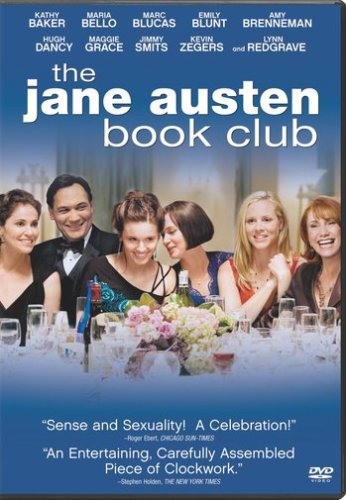
The Jane Austen Book Club DVD directed by Robin Swicord at AmazonIn Drivelry’s continuing mission to convert the obscure into ’scure’,  it is remarkable how some movies do so well at the box office and others do so undeservedly badly.

A great case in point is the film “The Jane Austen Book Club”. Despite the title you really don’t have to know anything about Austen to appreciate this film.

Written and directed by Robin Swicord its dialog sparkles along at a pace that it makes typical action pics look slow. With more layers than wedding cake you could watch it half a dozen times and still not pick up on all the jokes and nuances.

Ok it is a romantic comedy but it’s also a labor of love because behind a lot of the excellent jokes and gags are some serious and subtle points about relationships.

Labelled a ‘chick flick’ any man would enjoy the byplay in this film - there are a raft of muscular characters here and not just Sylvia’s gay daughter Allegra.  It is also full of surprise twists and shocks - you’d defy anyone to come up with anything so true-to-life awful as one of the opening scenes with Daniel and Sylvia in the restaurant.

Great film – terrible box office takings

Four Weddings and a Funeral DVD on Amazon But the thing that is really most shocking about “The Jane Austen Book Club is how such a good film did so relatively badly at the box office taking only $7 million in revenue.

“Four Weddings and a Funeral” (which is a veritable pastiche compared to ”Book Club”) took $245 million….  Even Swicord’s previous film “Little Women” took $50 million.

Narrow it down to Austen literary territory and the comparisons look equally bad:

  • “Bride and Prejudice” took $24 million
  • Keira Knightley’s 2005 “Pride and Prejudice” took $121 million
  • Emma Thomson’s 1995 “Sense and Sensibility” took $134 million
  • and the  recent biopic about Austen herself “Becoming Jane” took $37 million

Perhaps one could argue that Austen fans like their adaptations as close as possible to the original based on the above but it is still interesting to ask why ‘Book Club’ did so comparatively badly (unless you think all of the above are so much better than it is).

What went wrong with this movie?

Here are a couple of guesses which have more to do with marketing than anything else:

  •  why-oh-why did they call it “Jane Austen Book Club”? It’s like holding up a large sign to say “don’t come to this unless you are a) a woman and b) you ‘read’ with a capital R. Well, that’s 3/4ths of the filmgoing population gone then… What about Truths Not Universally Acknowledged? Read My Lips? The Club? Anything would have been better. Was Swicord so shocked when a producer said yes to her pitch (“I have this idea about a film about a book club…”) that she felt she had to stick with it?
  • nobody seems to have really liked Fowler’s book amongst my acquaintances although I appreciate that somebody liked it in order for it to end up on the New York Times’ bestseller list for 13 weeks.  Was the film too closely tied to the Fowler book but actually aimed at a different demographic?
  • did it need a more bankable star – would it have been the same movie with someone else as the female lead Jocelyn? It seems thoroughly unfair to even suggest this as Maria Bello played the role so well but would a Cameron Diaz or Michelle Pfeiffer have had more drawing power?  Would a better known male lead in the place of Hugh Dancy have delivered better box office returns – and again Hugh Dancy played Grigg’s role to perfection so it is unreasonable to suggest this on anything more than marketing grounds.
  • did it need to be rewritten to appeal to a slightly younger audience? As a 16 year old said the other day “it didn’t speak to me” – with it’s acutely drawn portraits of middle age as delineated in the Daniel sub-plot did it just leave a younger audience too much in the cold?

We’ll never know the answer of course but someone should look beyond the box office results above and give Robin Swicord more money to make another film, this time with a better marketing plan.

The only strangely Austen-ish happy ending outcome of all of this was that the film was nominated for the Gladd Media Award and lost to another greatly unappreciated film which Drivelry has also reviewed, Stardust. The co-stars of the two films, Hugh Dancy and Claire Danes, announced their engagement this year.

Posted under Kewl, Reviews, Unanswerable questions

This post was written by mike on August 18, 2009

Tags: ,

Australia, the movie: by way of Pearl Harbour, John Wayne, the Australian Tourism Commission (and Baz Luhrmann)

I’m writing this hiding in the bathroom from my partner, with whom I’ve just seen Australia, the movie. She liked it and thinks I need to disclose that I don’t like mangoes, vegemite and other Australian sacred objects.

This film had everything:

  • an aborginal noting in the end that Australia was for for ‘all of us’ (white and black) with a footnote about an apology in 2008 for the stolen generation
  • a lead male character referred to only through the film as ‘the drover’ (gosh do you think  they’re arguing that he is the quintessential embodiment of those heroes of the open plains) – I nearly choked on my popcorn when as Hugh and Co dragged the children away from ‘Mission Island’ where they had been trapped by the evil clergy the heroic aboriginal brother in law tells him “Drover you’ve got to take that mob of children home…” 
  • continual ersatz symbolism throughout the film targeting American movie-goers (let’s face it you’re not going to earn back your $150m+ budget just from Australians): the ‘Wizard of Oz’ theme tune,  John Wayne style river crossings, and let’s not forget homage to Pearl Harbour in the climactic bombing of Darwin by the evil Japanese
  • slo-mo shots of Hugh Jackman soaping his torso under the stars and rather cruel extended closeups of Nicole Kidman (tough on the 40+ generation)

All of this rendered in CGI-led hyper-realism and panoramic landscapes oddly reminiscent of Northern Territory tourism promotional videos (especially funny if you know the Kimberly region as they leaped from tourist spot to tourist spot).

Finally, just in case the above seems rather unbalanced, verging on un-patriotic, Nullah the kid was good and the score was good too.

Another one, where you suspect that there is one guy behind it, who has become so successful that nobody around them is being honest any longer.

Geez Baz, you needed an editor: 4 individuals in the script credits were clearly not enough.

Posted under Cliche watch

This post was written by mike on December 3, 2008

Tags: , , , ,