Finding the best blogs on the web for your personalized newspaper

Use Stumbleupon to find the best blogs on the web? - photo by majerleagues on Flickr licensed under Creative CommonsAs argued in“Online news: bloggers v newspapers”, we are entering a new era where the bundle of stories represented by current magazines and newspapers is being torn apart and being replaced by smaller publications and individual journalists/ writers blogging out there on the web.

With the aid of RSS feeds & cross-platform e-book software like Calibre (the equivalent of iTunes podcast subscriptions applied to blogs), and the e-reader of your choice like the Kindle DX or iPad,  you can now read the best blogs as a ‘personalized newspaper’, sitting feet up in the comfort of your own couch. Yep, the age of the personalized newspaper is here now, you no longer have to wait around for it to be lobbed onto your doorstep by the paperboy.

And with 100m+ odd blogs out there,  by anyone from your favourite novelist to the zany mommy-blogger types, surely there are bound to be some superb ones?

Well here comes the difficult bit.  How do you find them?

Does looking for the best blogs make sense in any case?

Mr Average? - photo from Flickr by psd licensed under Creative CommonsArguably it’s a stupid task to begin with, because isn’t the whole point of the web the fragmentation of audience and content, letting a thousand content flowers bloom? You no longer have to write for ‘Mr Average Interest’ because there will be someone in Guatemala who even finds the drivelry on Drivelry interesting (no offence to Guatemalans). 

Surely it’s a bit like asking ‘how do you find the best music to listen to’?

Well the unlikely you can do today -  the impossible takes a little longer. It is a reasonable question to ask where to find the best blogs. We all expect that art gallery curators can put together the best art in a particular period and it also seems reasonable that you should be able to find say, ‘the best economics blogs‘ or more narrowly even the best blogs on New York theater.

Perhaps there are even weirdos out there who would like to read a smattering of  the best economics blogs out there, coupled with best cartoons, and the best blogs on the implosion taking place in the publishing industry (a dangerously close description of my own interests).

General characteristics of the best blogs for your own personalized newspaper

Even though it may make sense to start your search (more later) in your particular subject of interest, there are a number of generic characteristics that you will need in your blogs:

  1. The blog will need to have full RSS (Really Simple Syndication) feeds.  People who set up their RSS feeds to only provide the first para are not going to work for your personalized newspaper (even though it might work better for their advertising revenue). You would end up on the train with your Kindle newspaper consisting of first paras. Kinda annoying huh? When investigating a new blog go straight to the RSS feed. If it’s not a full feed, move on.
  2. Blogs can’t be links to ’the best posts this week’ from other bloggers in that subject. Why bother? Again you’re after something that you can read on the run, in a plane, on the farm etc.  Sometimes it may well make sense to explore their idea of what blogs are best in a particular space - but you’ll probably end up adding that blog to your newspaper instead.
  3. Blogs can’t be video blogs.  Apart from reservations that you may have anyway about  whether video suits you as an information consumer it’s simply not supported in many e-readers. Yes, it is in the iPad (albeit not Flash-based video) but that leads to a whole other discussion about whether you are using your e-reader to read (either skim reading or in-depth) or whether you are after a portable computing device. Video isn’t supported by the Kindle.
  4. The blog needs to be regularly updated. One of the things you will find in your own wanderings of ‘best of blog sites’ (see below) is that half the blogs that are recommended to you were last posted to in 1996. Few bloggers heed the warning to write about what they like and you’ve got to really like your subject to keep going. For your own news service you won’t care if the blog is only published once a month (with RSS subscription software for your e-book like Calibre you can just set a retrieval interval of once a month) but once a year and you’re probably wasting your time even setting up a feed.

Best of blog directories and searches

A friend of mine who edits literary anthologies is hugely dismissive of search engines and considers that editors will always be essential and that you’ll always need an intermediary to curate information for you, “Google is useless“, she says, “it just returns so much crap!”

I have explained to her that Google partially makes decisions about what is important by looking at hypertext links created by humans to particular pieces of content (‘PageRank’) but in finding the best blogs there is an obvious flaw to Google in that ‘most popular’ – as expressed by the number of links to that content – is not necessarily ‘best’ (or we would be spending most of our time reading up on swine flu). 

Even where there is a more formal voting process for best blogs it suffers from the same issue of being driven by lowest common denominator numbers, and well known meta-blogging sites like Technorati also reflect their subject specificity (Technorati is great if you want to find out about technical blogs but not so good otherwise in my experience).

Sadly, the human-curated websites on great blogs like ‘Best of the Web’ (botw.org) or Eaton Web (eatonweb.com) seem to have a lot of out-of-date content and attempts to use these to browse interesting sites were not very successful (these days they look to me more like ‘pay to play’ linkfarms if you were going to be overly reductive).  Blogcatalog (blogcatalog.com) also seems not to live up to its home page promise “we’ve done the heavy lifting for you. Browse blogs by category to find the best in class”.

Software recommendation engines to find blogs you like

Here's a cool picture of a car crash - photo by irina slutsky on Flickr licensed under Creative CommonsWhat seems logical is a recommendation engine that matches your personal subject area interests with that of others who have the same interest and which only returns recommendations to pages that are current. Two significant players in this space are Digg who introduced a recommendation engine in 2008 and an older company in this space, Stumbleupon.

A key point to keep in mind is that recommendation engines involve a hefty time investment to produce good results (you’ve got to spend time telling them what you like).  Some commentators discount Digg on the basis that their recommendation engine tends to reinforce suggestions to pages and sites that your friends like rather than finding you ‘hidden gems’  so I focused on building up a Stumbleupon profile (which you do by giving a thumbs up or thumbs down to the pages they suggest).

Results have been mixed from Stumbleupon - after what I’d estimate at 5 hours of solid recommendations (much of what you will see is collegehumour.com style graphic humour) I’ve only selected 44 favourites from the pages I’ve been shown and I estimate I’ve found about half a dozen blogs that I like (yeah it’s entirely possible I’m just hyper-critical). 

For the moment I’m keeping going with Stumbleupon, to some extent out of sympathy for what is a great concept but a terrible name – stumbling is not exactly the most useful sounding activity is it?

Conclusion: it’s just plain hard to find a good recommendation source for blogs

Social Media Process v. 1.0With the emergence of e-readers in large numbers it seems to me that there is an opportunity here for someone to produce a better human-curated selection of great blogs than some of the moribund websites mentioned above like BOTW and Eaton, and possibly there is such a site but I was not easily able to find it (let me know in the comments). 

Producing a good recommendation software engine by contrast requires a great algorithm and a lot of users (Stumbleupon after several years has 10 million+ users) but when you consider that many of them would be inactive and therefore generating little recommendation data, and that they’ve got several hundred subject categories, Stumbleupon’s source of preference data looks a lot poorer (perhaps my literary editor friend was right after all).

The best source of good blogs I found in the end was via Tweets from people I follow on Twitter, so if you can get access to Twitter’s data that looks like a great source. Whilst it appears that Facebook leads sharing of content, Twitter seems to be the only ‘open’ source of information (i.e. you don’t have to be accepted as someone’s friend to see what they recommend).

Otherwise there must be someone in an organisation out there, perhaps at Google or an ISP, who has a lot of blog content preference information.

C’mon venture capitalists! With the explosion in electronic books, creating a good blog recommendation engine is a non-trivial (i.e. barriers to entry) and potentially lucrative problem to solve.

Posted under Unanswerable questions, Wait for release 2.0

This post was written by mike on April 6, 2010

Tags: , , , , , ,

The web escapes the computer screen: what the E-reader will do for unpublished information on the web

The next information wave - Photo by mikebaird from Flickr licensed under Creative Commons

The next information wave

It’s easy to hate the most over-used phrases used to describe the web age – paradigm shift, knowledge revolution, Web 2.0 etc.  

But hey we’ve all faced the tyranny of an empty page – it’s tough out there. And faced with amazing changes to how we locate information represented by Google and the other search engines it’s easy to reach for the bottle of superlatives.  

Even the growth of email has meant a phenomenal change to the way we consume and create information in the last 15 years as documents and comments flow back and forth in minutes that used to take faxes, printers, and letters hours or days.  

Despite all these examples of card-carrying “gee whiz”  moments however it looks like we are just about to be swept up in another wave.  

We are just starting to consume knowledge in another way which may result in an equally dramatic lifestyle change when compared to the growth of search engines, or the early days of the web itself.  

Amazon's Kindle Reading Device - the A4 size DXThe on-rushing wave is the e-book (or more properly the ‘E-Reader’), with an estimated 10 million being sold by the end of this year just in the US alone and dozens of different E-Readers in the works from different companies emerging in the next 12 months – with a combined marketing budget in the hundreds of millions that will make the recent Apple iPad launch look like a hiccup.  

On the surface of it is this just another example of hyperbolic silliness? Because isn’t the E-Reader just another way to consume books that we’re already reading in hardcopy anyway, and as many have pointed out there are a lot of advantages of traditional hardcopy over the electronic alternative?Illegible computer screen text - photo by Naufragio on Flickr licensed under Creative Commons  

What is interesting about E-Readers is not the ‘E-book’ part at all. Instead E-Readers are going to very rapidly reshape how we consume information on the web. This is not about a ‘new device’ it’s about a new way to consume information, because as is somewhat obvious most of the information on the web is just not available in hardcopy form at all. And that really matters.  

Backlit screen reading is hard to do (sorry Apple I know you’re trying with the iPad). It’s hard on your eyes,  it’s not very portable (try reading a laptop with your feet up), and in this information-packed age unless you’re looking at a huge screen it is hard to skim read and quickly identify the key points in screen-based information.  

This has lead to an emphasis on other aspects of screen-based information that compensate for these drawbacks of the web on a computer screen by adding new functionality: dense hypertext links to make cross referencing easy, the ability to comment and interact with authors as represented by blogs, the ability to locate and reassemble information in many different ways as represented by search engines, and in most journalism courses a recognition that writing for the web requires a specific style (admonitions to not write more than two sentence paras etc).  

The RSS button - freedom from the screen? Photo by HiMY SYeD / photopia on Flickr licensed under Creative CommonsBut the E-Reader is changing that (read “Customized newspapers on e-books: Calibre cross-platform e-book subscription management” to see how you can subscribe to websites out there on the web on your E-Reader, via their RSS feeds,  just like you can subscribe to a podcast on iTunes).  

What happens when everything from the web is as portable and easy to read as paper?  

It’s not JUST the E-Reader: the way this is going to turn our information-consuming lives upside down is driven by a groundswell of the growth of machine-readable info feeds on sites represented by Really Simple Syndication, and emerging platforms like Calibre which enable you ’subscribe’ to any website on any E-Reader – for FREE.  

The E-book just happens to be the final crest of the wave which is about to sweep away already undermined sections of the publishing industry.  

Still not convinced?  

The only thing worse than a ‘paradigm’ shift is an attempt to predict the future so here goes with a few near-term predictions:  

  1. the world of journalism is about to get vastly more competitive – journalists in a newspaper will be competing with bloggers with more specialist knowledge who previously had limited circulation because you couldn’t purchase your average blog conveniently on a newstand or read it on the way to work on the train. The blogger is providing the information for free.
  2. How do you find the best? Photo by Diabolic Preacher on Flickr - licensed under Creative Commonsintermediaries that seek out big stories will get more important in their own verticals (wherever those stories are) whether they are using algorithms like Google or whether they are using human curated approaches like ‘The Week’, or social media mechanisms like Stumbleupon or Digg. Try and find for example, amongst the 100m+ or so out there which are the most entertaining blogs? To some extent this question was irrelevant  if those blogs didn’t get read – but not any more.
  3. new ways of consuming stories will arise – for instance ‘collaborative reading’. On my Kindle or Sony Reader or iPad or whatever why should I not be able to view annotations on a text by my colleagues, or classmates, or friends?
  4. we’re not talking individual wikis – we’re talking wiki world – why buy a ‘How To’ manual for  your motorcycle when there is a completely portable version?
  5. traditional publishers who are congratulating themselves on being web savvy like the New York Times or Guardian are going to come under even more pressure because E-Readers in many cases will have the effect of destroying ad revenue and their ability to really track readership. With the aid of software on an E-Reader like Calibre this is the equivalent of Tivo for the publishing world: in your Kindle DX via Calibre no javascript is active (so Google Analytics aint going to know you’ve read the story) all it knows is that someone downloaded their RSS feed (not which particular stories were read).  And fancy ads are not going to come across because people writing recipes to extract your content with Calibre simply don’t want them.  Even if you instituted counter-measures by embedding an ad image joined with a story image, it’s almost the equivalent of going back to the flat ad serving done in newspapers. Free at a blog near you - photo from Flickr by Rainbow Project licensed under Creative Commons
  6. even the acknowledged guru of the web commerce world, Amazon, may be shooting themselves in the foot. They want you to buy e-books from them – but why? If you can read any old PDF or niche website out there on the web from the comfort of the couch? Or a million free book titles? I bought an Amazon Kindle DX and have yet to buy a book on it (but thanks Amazon anyway for paying the wireless subscription charges).
  7. if it isn’t already obvious the E-reader is going to reduce further the cost of information globally even more: expect to add value with your startup company by better locating information, or better curation, but expect an uphill road if you think it’s about unique content (Mr Murdoch take note).
  8. a bit like podcasting has broken the barriers to entry for local radio talk shows your decision is not ‘which paper do I buy in my home town’, instead it’s ‘which blogs do I want to read from the entire internet?’ Publications are becoming ‘unbundled’ and publishing deadlines paradoxically may actually become less important in an age of instant satisfaction. Why should I read some crap which some journalist stitched together at the last moment to make the Sun weekend edition when I can read a combination of bloggers who only produce pearls once a month? 

Like the sound of this new world or hate it?  

Is it not going to happen at all?  This is a blog – talk back.

Posted under Kewl

This post was written by mike on February 22, 2010

Tags: , , , , , ,

Expect not to read e-books on your e-reader when you’re buying it

Oh dear, I'm reading less books now I have an e-reader - Photo from Flickr by Aprilzosia licensed under Creative CommonsWith the aid of the public domain Calibre e-book management application, which enables you to automatically subscribe to any news website (via RSS) and the increasing prevalence of the open (non DRM) EPUB electronic book formats that you can dump Adobe Acrobat PDFs to, you may find that books are the last thing you read on your e-book.   Let’s face it, paperbacks are easily available.   Where e-books really come into their own (assuming you’ve installed Calibre)  is in pulling down content from the web (and making it comfortable to read anywhere without a computer), content you normally cannot get in hardcopy unless you want to run your laser printer overtime.   Documents and news content like:  

  • those 140 page Annual Reports you have to read occasionally
  • various frivolous and not-so-frivolous blogs that you’d love to keep up with
  • mainstream news sites like the New York Times or the Economist where most of the major stories are actually carried for free online
  • niche news sites you’d like to be able to browse occasionally
  • 30-40 page PDFs that you have to read for work

If this sort of content appeals to you then it has definite implications for what sort of e-reader / e-book you buy.   For example, the following e-book features bear watching if you expect to be reading other things aside from books:  

  • screen size: a lot of news websites and large PDFs contain tables and images. Unlike standard text, tables become meaningless when you can’t see the row labels.  You need an e-book with a 10 inch screen to handle this type of A4 content to be able read effectively, but  most e-books come in significantly smaller sizes. Screen size is measured diagonally so an average size e-book with a 6″ screen actually has a screen width of around 3 and a half inches … you won’t see an A4 width table in that – you really need at least a 5 inch wide screen (which roughly equates to a 10″ e-book screen size).
  • battery life: as effectively a substitute printer you need a long battery life. You aren’t just going to be picking up your e-book as you sit back in bed at the end of an evening . Battery-draining features like wireless connectivity or colour LCD displays such as the new iPad provides need to be weighed up against battery life.
  • page-refresh rate: on the Sony PRS-505 page refresh rate is about a second. This is probably the maximum tolerable if you are going to be reading a lot of content. Make sure the page refresh rate is faster than a second.
  • data charges: if you’re going to avail yourself of all this valuable free content (if that’s not an oxymoron) do you really want to pay ongoing 3G charges for your reader? When you switch your machine on you will have dozens of publications to choose from all continually refreshed daily automatically by just plugging your e-book into your PC.  A current (or in the case of Amazon ‘implied’) 3G mobile data charge just doesn’t seem necessary.  Assuming you have a smartphone if you really want time-sensitive web content you can always use that.
  • rich media support: closely related to the above issue, a 3G connection where you pay volume-related data charges could turn out to be quite expensive if your e-book supports rich media like video (for example the Apple iPad). Many of the news sites you are likely to use contain rich media (or in the case of blogs badly optimized large images) and you could even find that you’re paying to watch rich media ads!

At least at the moment your choice of e-readers that fit these criteria is pretty limited (a nice comparision table, from which the simplified table below is derived, can be found on the MobileRead website).  The iRex Digital Reader probably claims the high ground with a 10 inch display but has a notoriously short battery life and at over $800 is quite expensive. The Kindle DX at 9.7 inches looks better price-wise and it’s claimed it will run for 2 weeks with wireless off – but it seems likely that The 9.7" Kindle DX from AmazonAmazon will impose some sort of data charge as their Terms and Conditions state:  

“You may be charged a fee for wireless connectivity for your use of other wireless services on your Device, such as Web browsing and downloading of personal files, should you elect to use those services. We will maintain a list of current fees for such services in the Kindle Store. Amazon reserves the right to discontinue wireless connectivity at any time or to otherwise change the terms for wireless connectivity at any time, including, but not limited to (a) limiting the number and size of data files that may be transferred using wireless connectivity and (b) changing the amount and terms applicable for wireless connectivity charges.”  

If you need an e-book now (and if information you read is a key part of your job it’s worth  it!)  then probably the Kindle DX is the only option (and at the moment anyway the data charges are not an issue because you can leave wireless switched off and there is no annual charge imposed by Amazon).   However if you’re prepared to watch and wait, there are other large-screen devices emerging – devices and their estimated release dates below (see the MobileRead site for more):

Brand HanLin eBook iRex Amazon Kindle QUE Skiff enTourage Systems
Model A9 (unreleased) Digital Reader 1000 Kindle DX QUE proReader (pre-order) Skiff Reader enTourage eDGe (unreleased)
Display Size 9″ 10.2″ 9.7″ 10.5″ 11.5″ 9.7″
Battery Life ? 10 hrs with EVDO: “4 days”, without: “up to two weeks” “measured in days not hours” One week 16+ hrs
Other Interfaces USB 2.0 (charging), headphone, WiFi 802.11g, USB 2.0 (charging); 1000SW only: WiFi 802.11b/g and Bluetooth USB 2.0, headphone, EVDO/CDMA USB 2.0 (charging), Bluetooth, WiFi 802.11g, 3G (US: AT&T) USB 2.0 (charging), headphone, WiFi 802.11g, 3G (US: Sprint) 2 x USB, headphone, WiFi 802.11b/g, Bluetooth, 3G (optional), 1.3 Megapixel camera, internal microphone and speakers
Price US$??? / €350 US$859 US$489 / €n.a. US$799 US$??? US$490
Release Date April, 2010 2008 10-Jun-09 15-Apr-10 2010 Feb-10

Posted under Reviews

This post was written by mike on January 28, 2010

Tags: , , ,

Customized newspapers on e-books: Calibre cross-platform e-book subscription management

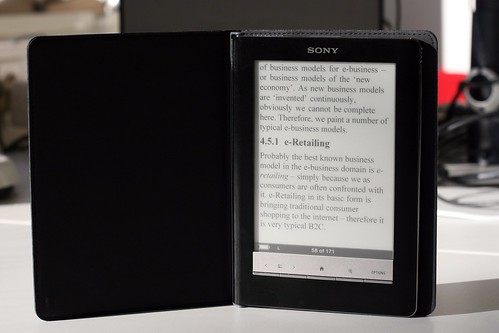
Sony E Book showing the crispness of the e-ink display with no retouching - PRS-505 perfectly adequate as customised newspaper platform - photo by egon on Flickr licensed under Creative CommonsAmidst the turmoil in the newspaper publishing market there is one big problem for journalists leaving the safe-ish harbour of their big name publications and starting to experiment out on their own (if you are still wondering why you should be doing this read this as to why your safe harbour aint safe).

It’s distributing your blog to your readers.

Distributing your blog

Talking about distribution seems kind of odd in a way. Kee-rist, this is the world wide web isn’t it? Surely there are no problems there?

Well of course there are.  The majority of the population rarely read blogs at all. Blogs aren’t exactly a core part of their reading habits.

On commercial sites the volume of RSS-sourced subscriptions and even email-subscription  page reads usually make up the minority of traffic (RSS is barely a rounding error) and the ever present big brother Google accounts for 75% of traffic.  And of course Google readers are not ‘regular’ readers are they? They just happen to be doing a search where your blog came up.

RSS news readers, while they are available in all sorts of flavours (dedicated desktop software apps and web based ones like Google News Reader), are still the province of the technorati or news junkies.

The big hope for bloggers is of course the burgeoning electronic book reader market. With estimates that Amazon has sold about 1.5m Kindles so far  and 6m new e-book readers expected to be sold in the US alone this year, e-book readers are fast becoming mainstream, but at this stage a lot of e-book readers seem just that:  mainly for buying books (ignoring the Amazon hype that they sold more electronic books on Christmas Day than real ones – what exactly did anyone expect).

We can all buy books in hardcopy – we obviously can’t get blogs that way.

Drivelry on the KindleFor bloggers the Kindle and Sony Reader were still relatively problematic as a distribution method because Amazon charged a subscription for you to subscribe to your favourite blog (imagine Dell charging you every time you downloaded a web page!) and required the blogger to sign up for the Kindle program for which Amazon generously gives you 30% of the revenue they earn.

And Sony’s reader has only just gone wireless with the ‘Reader Daily Edition’ targeted at newspapers.

Both the Sony and Kindle readers rely on an ongoing 3G connection which must be paid for somehow. The Sony PRS-900 unit (currently on back-order since they’ve sold out) for example is a minimum $15 per month.

Of particular interest for would-be bloggers wondering how they are going to get distributed to a mainstream readership is an e-book which does not require you to sign up for some sort of subscription for wireless access (a notable issue at the moment given the number of competing e-readers emerging, many of which are unlikely to exist in 5 year’s time), and being able to make a blog available all the time on the device.

Calibre

The most interesting development in this regard is not the hardware e book devices at all but public domain sofware that is emerging that will enable you to keep your e-book (whatever it is) synchronized with the bloggers you wish to follow (usually via RSS).

Finally, in following up on a concept that emerged way back in the mid 90s, you really can have a customised newspaper (for free) that is just as portable as your normal newspaper.

This missing piece in the jigsaw that gets you your customised newspaper effortlessly on your ebook today is a piece of free public domain software called Calibre, which has already been downloaded 500,000 times. Calibre is cross platform – for example it supports both Sony and Kindle readers as well as others.

Calibre: free, cross-platform blog and news management for your E Book

Calibre: free, cross-platform blog and news management for your E Book

As with podcasts, Calibre will automatically synch free RSS versions of blogs (as well as log-in versions of major publications like FT.com or the New York Times by supplying your username and password during configuration) with your e-book. All you have to do is plug in your e-book to the PC and Calibre squirts all the content across (and with the WiFi e-readers emerging like PlasticLogics it is likely you won’t even have to do that at some stage in the near future).

While the new Plastic Logic e-book for example touts about 30 news sources Calibre out of the box already supports 400 mainstream news sources for free - in multiple languages at the time of writing with more being added every day. And it is simple to add an additional news source of your own like your favourite blogs just by telling it the location of that blog’s RSS feed. Then tell Calibre when you want to synchronise (once a day at 9am for example) and you’re done!

You don’t have to wait: you can put together a customised newspaper template for yourself out of your favourite blogs today, and you can do it without paying a subscription charge with practically any e-book out there. If your e-book reader is WiFi or 3G equipped then the hyperlinks that show up in the publications that you’re reading will be active, but if you’re using say a more basic e-book like my Sony PRS-505 you are still way ahead of the non-e-book world.

PS If you use Calibre already (or after reading this article) you are reading publications where the ‘recipe’ has been written by Darko Miletic. To help him keep purchasing devices to test recipes on you can contribute here (Chip In below).

Posted under Reviews

This post was written by mike on January 17, 2010

Tags: , , ,

Online news: bloggers v newspapers – will the lowest cost base win?

Financial forecasts look negative for newspapers

Photo by Zarko Drincic from Flickr licensed under Creative CommonsThere are some nervous investors in the newspaper world.  Even after the recent 30% lift in the broader stockmarket, newspaper stocks like the New York Times Company and the Washington Post Company are trading on price to cashflow multiples of 4.2 and 6.8, where their 3 year averages were 11.8 and 10.6 respectively (Gannet actually trades at 1.8 x cashflow - albeit with a lot of debt).

Newspapers were seeing revenue decline year on year even before the credit crunch started. From the peak in 2005 of about $50 billion in newspaper ad revenue in the US,  revenue declined to $38bn in 2008.

Warren Buffett wouldn’t buy a newspaper these days for any price and newspapers themselves (those that are left after companies like Tribune have filed for bankruptcy and others have shut down) are even pleading for charitable status before those oh-so-friendly politicians.

The public already seems to be voting with their feet with the Pew Research Centre results showing that the percentage of Americans getting most of their national and international news from the web has gone from 15% in 2001  to about 40% today. Environmentally insensitive as my household is, it also seems tactless to  be throwing hunks of trees out with the rubbish every week in this age of global warming concensus.

It’s fascinating (particularly for bloggers … Ahem..) to watch. Sort of like a slow motion car crash.

And it is indeed slow motion; back in the mid 1990s I worked for a  very large business magazine publishing group who were very concerned about the commodification of news on the web. This (listed) group’s response to the threat posed by the web was to spend quite a bit of money trying to build web based vertical business communities around subscription products where ‘news’ was only a small part of the offering (they were trying to sell conferences, lists, and databases etc).

Can the traditional news industry restructure before it’s too late?

Does the news industry ‘get it’ (including television news for that matter), or are they in terminal decline? And if the traditional news industry is in terminal decline where are we going to be getting our news from – who is going to take up the slack? Bloggers? Google News? None of the above?
Looking at the online output from a lot of newspaper websites you could easily come to conclusion that on the surface they don’t get it.

The response of most papers to these strategic challenges, it seems to me, is to put in systems so they can multi-purpose copy to put out web versions and hardcopy versions at the same time. Like … errrmmm … wow ….

As an approach it’s likely to be fundamentally flawed because screen reading habits are simply different from hardcopy reading habits (so you can’t easily re-purpose for both). For example conventional advice onscreen is to write no more than 2 sentence paras, use online emphasis tools like colour etc where appropriate, and heavily use subheadings.

Another key point is that online the unit of consumption is not the newspaper ‘Section’ but rather the individual story itself, much as in the online music industry consumers increasingly buy singles through websites like iTunes rather than albums.  The individual article becomes the point where most people directly enter the parent website – so links from an article to your other articles and similar techniques to generate traffic within a website become far more important than in a hardcopy publication.

Most newspapers seem not to understand search engine optimisation

Another fundamental problem that is easily recognisable on your favourite newspaper’s website is an inability to respond fully to the needs of search engine optimisation. If you want to boost your online advertising revenue you  need to pull in punters who are actually actively looking for information via a search engine rather than hoping that they will serendipitously spot your ad at the right time. You don’t have to be a genius to realize that a buyer who is actively looking is worth paying more for as a marketeer.  As a publisher you also need to recognise that (typically) 75% of the traffic to your website will come from search engines.

Google ranks words that occur in titles as more important than words that occur in body text. Yet newspaper subeditors seem to think they are principally employed to produce clever puns (‘Shopping Maul’ or ‘Welcome to the House of Funds’ in a business publication I just read) and subeditors also seem to be singularly thoughtless when it comes to choosing commonly used keywords to please Google and Co. For example, have a look at the titles on the New York Times online. Even where newspapers will go as far as encoding the title in the URL (e.g. the title of this article on Drivelry.com if you look at the url) the keywords in the title are often highly unlikely to be searched for.

To put this another way, the average blogger who uses Wordpress straight out of the box (the free pubic domain software that underpins this blog) is likely to have better search engine optimisation than most newspaper websites.

The average blogger is also likely to be heavily scrutinizing Google’s Analytics plug-in to track readership from the first day they start blogging, to see what sort of response they get from their audience. In many publishing groups in my experience that sort of data probably never even gets out of the IT Department down to the journalist…

Cost-cutting on a newspaper doesn’t get you to profitability though

Printing and distribution account for about half a newspaper’s costs. So couldn’t you just shut down the presses?

Probably not.

If say the New York Times managed to halve its quarterly operating expenses, by dropping production of the physical paper, its online advertising revenues would still only cover about a fifth of its operating expenses.

As an article late last year in the Financial Times, Lex Column (link to the original quoted on the Magforum blog) said:

“To break even as an ad-funded digital-only business, with a quarterly cost base of, say, $338m, the New York Times – already the No. 1 newspaper website in the US – would either need 4 times as many unique users or ad rates 4 times as high as today’s, or some combination of the two.”

So where are we going to be getting our news from in 5 years time?

Photo by AlanCleaver 2000 from Flickr licensed under Creative CommonsThis is an issue which has been exercising that compulsory oracle for news hounds, ‘On the Media’ (who now even have a specific theme tune for business models to save the news industry). In a recent interview  Brooke Gladstone interviewed ex journalist David Simon who harrumphed that:

 “The Internet is a marvelous tool, and clearly it is the information delivery system of our future. But thus far it does not deliver much first generation reporting. Instead, it leeches that reporting from mainstream news publications whereupon aggregating websites and bloggers contribute little more than repetition, commentary and froth.”


[I thought it important to validate his worst fears about bloggers by doing just that.]

He went on to say:

“The day I run into a Huffington Post reporter at a Baltimore zoning board hearing is the day that I will be confident that we’ve actually reached some sort of equilibrium. You know, the next 10 or 15 years in this country are going to be a halcyon era for state and local political corruption. It is going to be one of the great times to be a corrupt politician, all right?”

We are watching a fascinating drama play out: an irresistible force (the creation of increasing numbers of niche content sites written by bloggers and disseminated by aggregators and search engines) meeting an immovable object (the newspaper industry) and neither charitable status nor anything else is going to save the latter from being completely transformed.

Blogs versus newspapers: who will win the battle?

Let’s draw a veil over the likelihood of bloggers or mainstream journalists attending zoning hearings. Here is a 10 point list of why newspapers have their work cut out for them: 

  1. Hosting a blog costs nil (on say Wordpress.com) or $20 a month in hosting fees if you want to host it under your own domain name
  2. Bloggers use free graphics libraries under Creative Commons intellectual property rules that can be used to create professional looking articles e.g. free photos from Flickr in this blogPhoto by Mike Licht from Flickr licensed under Creative Commons
  3. Bloggers gain the inherent linking benefits from other bloggers (after keywords, linking is  a primary determinant of website results rankings on Google)
  4. Bloggers live and die by search engine optimisation (and therefore are extremely conscious of it)
  5. Bloggers close the feedback loop on whether their articles work by closely reviewing tracking data
  6. Bloggers have interests and expertise in specific subject areas that no generic journalist can match (let’s face it, some journalists are often a pale reflection of their phone books anyway) 
  7. Bloggers create sites that are extremely niche (the internet’s ‘long tail’ applies just as much to news consumption as shopping) yet because of the search engines they can be found. What publication (for example) would target the dozen or so people who would be interested in this article?
  8. Bloggers are going to write for free in many cases, for the same non-monetary reasons a lot of poorly paid authors write for the publishing industry
  9. Bloggers who don’t write for free will test to destruction the emerging revenue models that for the average newspaper journalist are the province of upper management: Adsense, affiliate programs, emerging electronic platforms like the Kindle, micro donations, pay-to-post, subscription lists (the old ‘controlled circulation list from the hardcopy publishing world) etc
  10. Bloggers use increasingly powerful publishing platforms like Wordpress that have developed whole software eco-systems around them (where the platform itself is free)

There are other points we could make e.g. whether individual bloggers are worth going after with a lawsuit, how well some of those bloggers write (or not) but you get the idea.  To put it perhaps unkindly it could be argued that it would be great if some local and national newspapers shut down and just got out of the way – there will be someone else around to do their job at a lower cost when they’re gone (probably out of work journalists).

But (it’s incontrovertible) …. screen reading sucks

Oh yeah. Fair point. We see this in websites that I consult on commercially- we track print requests from online articles and there are a hell of a lot of them. It may sound like biting the hand that feeds you but at almost 2000 words anyone who’s got this far in this article without printing it deserves a medal.

However the response to this objection is that screen-based reading is getting better every day and increasingly it’s not going to involve a stupid laptop computer that takes 5 minutes to boot, has a keyboard and other components you don’t need to read with, and whose battery dies after 2-3 hours.

When it comes to portable screen-readers the future is now. It’s pretty clear that screen reading devices that you can read with your feet up on the couch like the Kindle (reviewed last year at Drivelry.com)  are getting there with consumers, with estimates from Citigroup that Amazon sold 400,000 Kindle units in 2008.  The newest Kindle even has a text-to-speech function i.e. it will read a book to you aloud.

And again the economics of the cost of distributing a book electronically will eventually force readers to buy a Kindle or look-alike unless they want to pay double for the equivalent in paperback.

As of May 13th 2009, David Simon (mentioned in the On the Media interview above) would be doubly horrified to learn that Amazon (at a 30/70% revenue split in their favour - the same terms they generously offer major newspaper chains) now makes the Kindle platform available to all 41 million-odd bloggers out there as a sales channel. For the modest sum of $1.99 you can even have all the articles from this website (Drivelry.com) delivered automatically to your very own Kindle reader.  Disclosure: this is a plug, run, don’t walk etc etc].

Nobody expects the Kindle to be a significant source of revenue in the short term, but in the medium to long term this is the publishing equivalent of an earthquake.

Posted under Kewl

This post was written by mike on June 9, 2009

Tags: , , , ,

How far away is the electronic book for publishers and bloggers?

My household typically no longer buys newspapers.  Actually we rarely watch the television news either.

We get most ‘news’ via a couple of magazine subscriptions, podcasts (generally consumed in the car or whilst doing the washing up) and to a less extent online.

It seems we are not alone. The newspaper sector, for example in the UK and USA, is deeply unloved at the moment by investors, with ad revenue expected to fall in the USA by 16% or so over the next 2 years. In the UK the largest news publishing group, Trinity Mirror, has seen an 80% fall in its stock price over the last 2 years.

Companies like Trinity are therefore busily trumpeting the growth of their online properties to investors out there, the line being, “our readership and ad revenue is falling but hey look at the growth of this online revenue…”

Like the much awaited demise of cinema when television came along I’m not sure that newspapers will disappear (is everyone going to obtain their news from Adsense-funded individual bloggers out there? – I doubt it). However what would really help out these guys like Trinity is if they didn’t have to spend 40% of their revenue printing and distributing a big hunk of forest every day.

But let’s face it, the computer screen sucks for casual reading. An odd thing to say really when this is a blog (Windows users hit Alt+F4 now).

I have to admit that the blogosphere hasn’t been high on my reading list either.

The likely way I would consume blogs would be by RSS feed but I don’t even have a dedicated RSS reader (and haven’t explored the Windows IE RSS functionality) although I have been vaguely thinking this is where I would like to go:  getting ever closer to the ‘my newspaper’ ideas bruited about when I was working on websites in the heady days of the millenium. A large commercial website aimed at the business sector I’m involved with gets about 3.5% of page views via RSS feed: so RSS aint there yet (RSS is only double the number of article print requests we can see on the same site).  

So my suspicion is that people who currently read blogs generally write blogs, and they’re reading blogs primarily because blog writers they link to often link back, mutually feeding their blog’s respective Google PageRank scores.

What would change all of this however is that if a decent electronic book came along. And finally, it looks like within 3-5 years that is going to happen.

Amazon's Kindle reading device

Amazon’s Nov ‘07 launch of the Kindle has supposedly sold about 350,000 units, which is quite a lot for a device less than a year old, which has ongoing subscription charges to boot. Then there’s Sony’s Reader which only has USB connectivity (presumably that means forget subscribing to a blog RSS feed) and then there is the wifi-equipped Phillips iRex.  This aint like reading text on your PDA or computer - these ‘E Ink’ screens provide very clear typeface viewable in outside light conditions from multiple angles.

Sony's version of the electronic book

However despite the availability and initially encouraging sales it looks like they’ve not learnt from the music industry and digital rights management is rampant, so unlike a paperback you can’t give a copy of your Sony ebook to a friend. And on the Kindle you have to subscribe to Amazon’s mobile data service in order to subscribe to this blog…

What I’m waiting to buy (and possibly a few other people) is an electronic reader that works offline for normal books and with wifi for online RSS subscriptions, with no digital rights management. That’s the device I’m going to be sitting in a (wifi equipped) coffee shop reading.

And at that stage reading RSS-’my newspaper’ blogs may be an increasingly mainstream activity and a larger number of blogs will make sense from an ad revenue perspective.

Posted under Wait for release 2.0

This post was written by mike on September 7, 2008

Tags: , ,