Expect not to read e-books on your e-reader when you’re buying it

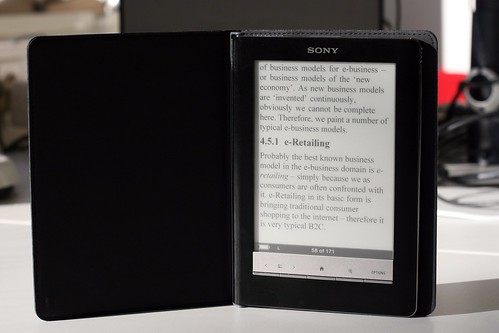
Oh dear, I'm reading less books now I have an e-reader - Photo from Flickr by Aprilzosia licensed under Creative CommonsWith the aid of the public domain Calibre e-book management application, which enables you to automatically subscribe to any news website (via RSS) and the increasing prevalence of the open (non DRM) EPUB electronic book formats that you can dump Adobe Acrobat PDFs to, you may find that books are the last thing you read on your e-book.   Let’s face it, paperbacks are easily available.   Where e-books really come into their own (assuming you’ve installed Calibre)  is in pulling down content from the web (and making it comfortable to read anywhere without a computer), content you normally cannot get in hardcopy unless you want to run your laser printer overtime.   Documents and news content like:  

  • those 140 page Annual Reports you have to read occasionally
  • various frivolous and not-so-frivolous blogs that you’d love to keep up with
  • mainstream news sites like the New York Times or the Economist where most of the major stories are actually carried for free online
  • niche news sites you’d like to be able to browse occasionally
  • 30-40 page PDFs that you have to read for work

If this sort of content appeals to you then it has definite implications for what sort of e-reader / e-book you buy.   For example, the following e-book features bear watching if you expect to be reading other things aside from books:  

  • screen size: a lot of news websites and large PDFs contain tables and images. Unlike standard text, tables become meaningless when you can’t see the row labels.  You need an e-book with a 10 inch screen to handle this type of A4 content to be able read effectively, but  most e-books come in significantly smaller sizes. Screen size is measured diagonally so an average size e-book with a 6″ screen actually has a screen width of around 3 and a half inches … you won’t see an A4 width table in that – you really need at least a 5 inch wide screen (which roughly equates to a 10″ e-book screen size).
  • battery life: as effectively a substitute printer you need a long battery life. You aren’t just going to be picking up your e-book as you sit back in bed at the end of an evening . Battery-draining features like wireless connectivity or colour LCD displays such as the new iPad provides need to be weighed up against battery life.
  • page-refresh rate: on the Sony PRS-505 page refresh rate is about a second. This is probably the maximum tolerable if you are going to be reading a lot of content. Make sure the page refresh rate is faster than a second.
  • data charges: if you’re going to avail yourself of all this valuable free content (if that’s not an oxymoron) do you really want to pay ongoing 3G charges for your reader? When you switch your machine on you will have dozens of publications to choose from all continually refreshed daily automatically by just plugging your e-book into your PC.  A current (or in the case of Amazon ‘implied’) 3G mobile data charge just doesn’t seem necessary.  Assuming you have a smartphone if you really want time-sensitive web content you can always use that.
  • rich media support: closely related to the above issue, a 3G connection where you pay volume-related data charges could turn out to be quite expensive if your e-book supports rich media like video (for example the Apple iPad). Many of the news sites you are likely to use contain rich media (or in the case of blogs badly optimized large images) and you could even find that you’re paying to watch rich media ads!

At least at the moment your choice of e-readers that fit these criteria is pretty limited (a nice comparision table, from which the simplified table below is derived, can be found on the MobileRead website).  The iRex Digital Reader probably claims the high ground with a 10 inch display but has a notoriously short battery life and at over $800 is quite expensive. The Kindle DX at 9.7 inches looks better price-wise and it’s claimed it will run for 2 weeks with wireless off – but it seems likely that The 9.7" Kindle DX from AmazonAmazon will impose some sort of data charge as their Terms and Conditions state:  

“You may be charged a fee for wireless connectivity for your use of other wireless services on your Device, such as Web browsing and downloading of personal files, should you elect to use those services. We will maintain a list of current fees for such services in the Kindle Store. Amazon reserves the right to discontinue wireless connectivity at any time or to otherwise change the terms for wireless connectivity at any time, including, but not limited to (a) limiting the number and size of data files that may be transferred using wireless connectivity and (b) changing the amount and terms applicable for wireless connectivity charges.”  

If you need an e-book now (and if information you read is a key part of your job it’s worth  it!)  then probably the Kindle DX is the only option (and at the moment anyway the data charges are not an issue because you can leave wireless switched off and there is no annual charge imposed by Amazon).   However if you’re prepared to watch and wait, there are other large-screen devices emerging – devices and their estimated release dates below (see the MobileRead site for more):

Brand HanLin eBook iRex Amazon Kindle QUE Skiff enTourage Systems
Model A9 (unreleased) Digital Reader 1000 Kindle DX QUE proReader (pre-order) Skiff Reader enTourage eDGe (unreleased)
Display Size 9″ 10.2″ 9.7″ 10.5″ 11.5″ 9.7″
Battery Life ? 10 hrs with EVDO: “4 days”, without: “up to two weeks” “measured in days not hours” One week 16+ hrs
Other Interfaces USB 2.0 (charging), headphone, WiFi 802.11g, USB 2.0 (charging); 1000SW only: WiFi 802.11b/g and Bluetooth USB 2.0, headphone, EVDO/CDMA USB 2.0 (charging), Bluetooth, WiFi 802.11g, 3G (US: AT&T) USB 2.0 (charging), headphone, WiFi 802.11g, 3G (US: Sprint) 2 x USB, headphone, WiFi 802.11b/g, Bluetooth, 3G (optional), 1.3 Megapixel camera, internal microphone and speakers
Price US$??? / €350 US$859 US$489 / €n.a. US$799 US$??? US$490
Release Date April, 2010 2008 10-Jun-09 15-Apr-10 2010 Feb-10

Posted under Reviews

This post was written by mike on January 28, 2010

Tags: , , ,

Customized newspapers on e-books: Calibre cross-platform e-book subscription management

Sony E Book showing the crispness of the e-ink display with no retouching - PRS-505 perfectly adequate as customised newspaper platform - photo by egon on Flickr licensed under Creative CommonsAmidst the turmoil in the newspaper publishing market there is one big problem for journalists leaving the safe-ish harbour of their big name publications and starting to experiment out on their own (if you are still wondering why you should be doing this read this as to why your safe harbour aint safe).

It’s distributing your blog to your readers.

Distributing your blog

Talking about distribution seems kind of odd in a way. Kee-rist, this is the world wide web isn’t it? Surely there are no problems there?

Well of course there are.  The majority of the population rarely read blogs at all. Blogs aren’t exactly a core part of their reading habits.

On commercial sites the volume of RSS-sourced subscriptions and even email-subscription  page reads usually make up the minority of traffic (RSS is barely a rounding error) and the ever present big brother Google accounts for 75% of traffic.  And of course Google readers are not ‘regular’ readers are they? They just happen to be doing a search where your blog came up.

RSS news readers, while they are available in all sorts of flavours (dedicated desktop software apps and web based ones like Google News Reader), are still the province of the technorati or news junkies.

The big hope for bloggers is of course the burgeoning electronic book reader market. With estimates that Amazon has sold about 1.5m Kindles so far  and 6m new e-book readers expected to be sold in the US alone this year, e-book readers are fast becoming mainstream, but at this stage a lot of e-book readers seem just that:  mainly for buying books (ignoring the Amazon hype that they sold more electronic books on Christmas Day than real ones – what exactly did anyone expect).

We can all buy books in hardcopy – we obviously can’t get blogs that way.

Drivelry on the KindleFor bloggers the Kindle and Sony Reader were still relatively problematic as a distribution method because Amazon charged a subscription for you to subscribe to your favourite blog (imagine Dell charging you every time you downloaded a web page!) and required the blogger to sign up for the Kindle program for which Amazon generously gives you 30% of the revenue they earn.

And Sony’s reader has only just gone wireless with the ‘Reader Daily Edition’ targeted at newspapers.

Both the Sony and Kindle readers rely on an ongoing 3G connection which must be paid for somehow. The Sony PRS-900 unit (currently on back-order since they’ve sold out) for example is a minimum $15 per month.

Of particular interest for would-be bloggers wondering how they are going to get distributed to a mainstream readership is an e-book which does not require you to sign up for some sort of subscription for wireless access (a notable issue at the moment given the number of competing e-readers emerging, many of which are unlikely to exist in 5 year’s time), and being able to make a blog available all the time on the device.

Calibre

The most interesting development in this regard is not the hardware e book devices at all but public domain sofware that is emerging that will enable you to keep your e-book (whatever it is) synchronized with the bloggers you wish to follow (usually via RSS).

Finally, in following up on a concept that emerged way back in the mid 90s, you really can have a customised newspaper (for free) that is just as portable as your normal newspaper.

This missing piece in the jigsaw that gets you your customised newspaper effortlessly on your ebook today is a piece of free public domain software called Calibre, which has already been downloaded 500,000 times. Calibre is cross platform – for example it supports both Sony and Kindle readers as well as others.

Calibre: free, cross-platform blog and news management for your E Book

Calibre: free, cross-platform blog and news management for your E Book

As with podcasts, Calibre will automatically synch free RSS versions of blogs (as well as log-in versions of major publications like FT.com or the New York Times by supplying your username and password during configuration) with your e-book. All you have to do is plug in your e-book to the PC and Calibre squirts all the content across (and with the WiFi e-readers emerging like PlasticLogics it is likely you won’t even have to do that at some stage in the near future).

While the new Plastic Logic e-book for example touts about 30 news sources Calibre out of the box already supports 400 mainstream news sources for free - in multiple languages at the time of writing with more being added every day. And it is simple to add an additional news source of your own like your favourite blogs just by telling it the location of that blog’s RSS feed. Then tell Calibre when you want to synchronise (once a day at 9am for example) and you’re done!

You don’t have to wait: you can put together a customised newspaper template for yourself out of your favourite blogs today, and you can do it without paying a subscription charge with practically any e-book out there. If your e-book reader is WiFi or 3G equipped then the hyperlinks that show up in the publications that you’re reading will be active, but if you’re using say a more basic e-book like my Sony PRS-505 you are still way ahead of the non-e-book world.

PS If you use Calibre already (or after reading this article) you are reading publications where the ‘recipe’ has been written by Darko Miletic. To help him keep purchasing devices to test recipes on you can contribute here (Chip In below).

Posted under Reviews

This post was written by mike on January 17, 2010

Tags: , , ,

Jane Austen: pride and prejudice in movieland in “The Jane Austen Book Club”

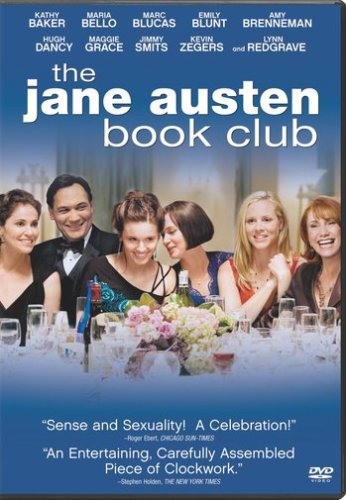
The Jane Austen Book Club DVD directed by Robin Swicord at AmazonIn Drivelry’s continuing mission to convert the obscure into ’scure’,  it is remarkable how some movies do so well at the box office and others do so undeservedly badly.

A great case in point is the film “The Jane Austen Book Club”. Despite the title you really don’t have to know anything about Austen to appreciate this film.

Written and directed by Robin Swicord its dialog sparkles along at a pace that it makes typical action pics look slow. With more layers than wedding cake you could watch it half a dozen times and still not pick up on all the jokes and nuances.

Ok it is a romantic comedy but it’s also a labor of love because behind a lot of the excellent jokes and gags are some serious and subtle points about relationships.

Labelled a ‘chick flick’ any man would enjoy the byplay in this film - there are a raft of muscular characters here and not just Sylvia’s gay daughter Allegra.  It is also full of surprise twists and shocks - you’d defy anyone to come up with anything so true-to-life awful as one of the opening scenes with Daniel and Sylvia in the restaurant.

Great film – terrible box office takings

Four Weddings and a Funeral DVD on Amazon But the thing that is really most shocking about “The Jane Austen Book Club is how such a good film did so relatively badly at the box office taking only $7 million in revenue.

“Four Weddings and a Funeral” (which is a veritable pastiche compared to ”Book Club”) took $245 million….  Even Swicord’s previous film “Little Women” took $50 million.

Narrow it down to Austen literary territory and the comparisons look equally bad:

  • “Bride and Prejudice” took $24 million
  • Keira Knightley’s 2005 “Pride and Prejudice” took $121 million
  • Emma Thomson’s 1995 “Sense and Sensibility” took $134 million
  • and the  recent biopic about Austen herself “Becoming Jane” took $37 million

Perhaps one could argue that Austen fans like their adaptations as close as possible to the original based on the above but it is still interesting to ask why ‘Book Club’ did so comparatively badly (unless you think all of the above are so much better than it is).

What went wrong with this movie?

Here are a couple of guesses which have more to do with marketing than anything else:

  •  why-oh-why did they call it “Jane Austen Book Club”? It’s like holding up a large sign to say “don’t come to this unless you are a) a woman and b) you ‘read’ with a capital R. Well, that’s 3/4ths of the filmgoing population gone then… What about Truths Not Universally Acknowledged? Read My Lips? The Club? Anything would have been better. Was Swicord so shocked when a producer said yes to her pitch (“I have this idea about a film about a book club…”) that she felt she had to stick with it?
  • nobody seems to have really liked Fowler’s book amongst my acquaintances although I appreciate that somebody liked it in order for it to end up on the New York Times’ bestseller list for 13 weeks.  Was the film too closely tied to the Fowler book but actually aimed at a different demographic?
  • did it need a more bankable star – would it have been the same movie with someone else as the female lead Jocelyn? It seems thoroughly unfair to even suggest this as Maria Bello played the role so well but would a Cameron Diaz or Michelle Pfeiffer have had more drawing power?  Would a better known male lead in the place of Hugh Dancy have delivered better box office returns – and again Hugh Dancy played Grigg’s role to perfection so it is unreasonable to suggest this on anything more than marketing grounds.
  • did it need to be rewritten to appeal to a slightly younger audience? As a 16 year old said the other day “it didn’t speak to me” – with it’s acutely drawn portraits of middle age as delineated in the Daniel sub-plot did it just leave a younger audience too much in the cold?

We’ll never know the answer of course but someone should look beyond the box office results above and give Robin Swicord more money to make another film, this time with a better marketing plan.

The only strangely Austen-ish happy ending outcome of all of this was that the film was nominated for the Gladd Media Award and lost to another greatly unappreciated film which Drivelry has also reviewed, Stardust. The co-stars of the two films, Hugh Dancy and Claire Danes, announced their engagement this year.

Posted under Kewl, Reviews, Unanswerable questions

This post was written by mike on August 18, 2009

Tags: ,

Review of ‘The Wonderful World of Dissocia’ the play by Anthony Neilson

A dilemma for you: how do you review something about which you want to say nothing?

If you read the plot summary for this play you’d probably think it was terrible (so don’t). Stop.  Don’t Google it. In this case ignorance  is bliss.

To give anything much in the way of detail would ruin a play that for its surprise value, clever construction, and important issues, deserves an audience expecting nothing but to be impressed by something wholly original.

The Sydney Theatre Company production we saw starred Justine Clarke (from Playschool) who had the perfect demeanour to carry off the silliness and seriousness required.

My only way around the dilemma that I began this with is to point in the direction of other texts that are on this wavelength (at least part of it).

This is not a children’s play but remember ‘The Phantom Tollboth, about a boy called Milo who sets off in his car through an allegorical world with a dog called Tock?

If you’ve never come across TPT then ‘Alice in Wonderland’ is probably another text whose fantasy world will live with you a long time time, like ‘The Wonderful World of Dissocia’.

It’s a must-see and so well written that even a high school production would probably be thought-provoking.

Posted under Reviews

This post was written by mike on April 28, 2009

Tags: , ,

Baby boomers: guilt or selfishness? Leisureville and the geriatric generation

 My (late 20s) sister gets some flak about being part of generation Y. You know, that generation that has:-

 ’an expectation that there will always be a job out there and that you should be able to get to the top job of any average organisation in under 2 years.’

That sort of criticism may be a little more muted now that we are watching a synchronised world economic downturn play out and Gen Y’s adjust to a different world, but, one of the most interesting things about the criticism to me is actually what it says about the (usually) baby boomer speaker.

I am fascinated by the mindset of baby boomers (those born during the post war baby boom between 1946 and 1964) because arguably all of us afterthoughts born after ‘64, whether generation X (60s-70’s) or generation Y (80s onward), are not so different, in that we have lived lives relatively similar to our parents the boomers.

What do I mean by this?

I mean that the mindset of most kids is not a little based on the mindsets of their parents… their expectations of economic achievement, friends, and the general threat level in the world is picked up by osmosis from Mum and Dad. 

However in contrast to Gen X or Gen Y the baby boomer’s parents had an almost unimaginable mindset. Imagine you are a baby boomer, born in say 1947. Your parents, and their parents (your grandparents) saw:

  • two world wars
  • the holocaust
  • the Great Depression
  • the post war Spanish flu epidemic (which in 10 months in 1918 killed 22 to 40 million people worldwide)

My parents the boomers are arguably the guilt generation of the last 100 years. 

They must subconsciously or not spend a bit of time thinking to themselves ‘how did I deserve such an easy life when my parents had a so much harder one?’ They didn’t have to fight a war (in most places), struggle to put basic food on the table for their family through a depression, or watch swathes of people they knew die in an epidemic whose death toll was highest not amongst the elderly, but in the 15 to 40 age group. Their parents had to live through all of this stuff.

What impact might this have had – and this is not a rhetorical question – if you have a view I’d love to hear it.

Are boomers striving to prove something? Are they still expecting the sky to fall, which had fallen on their parents? Is their civic identity (their propensity to join political parties for example) a reaction to their parents who needed to stick together in their social group to survive the adversities thrown at them? Just how much of their value system is based on values that were needed to survive in the world of their parents?

And yep, if you haven’t already guessed, we all need to understand our parents.

The Case for the Prosecution: Leisureville

There is also a view that the boomers are selfish, self obsessed, and just a trifle ’up themselves’ as they say in the Antipodes.

The case is made well by Andrew Blechman in ‘Leisureville’ a sociological exploration of a couple of gated retirement villages in the US where 55+ year olds drive round in golf  carts, children are banned, and Viagra has led to a re-run of the 60s.

As an early 40s type participating in late parenthood the zero children tolerance policy is somewhat appealing; many is the time where I have had those one sided conversations with parents of young children where they spend their entire time watching their kid, make no eye contact, and wouldn’t have a clue what you’d said.

Leisureville is somehow unconvincing however if you are of a live-and-let-live disposition. As many reviewers said, if you paid your taxes all your life and that’s what you choose to do then so be it. Let’s face it for every golf obsessed retirement community like this there are a hundred that you would never wish on your nearest and dearest aged parent.

It seems no more less appealing or worthy of moral judgement than baby boomers wandering from coast to coast in their RVs or caravans as they visit parks and scattered children: if they want to do it, great.

Personally, I could not help wondering re Leisureville, “I wonder if my parents would like something like this?”

Posted under Reviews, Self doubt, Unanswerable questions

This post was written by mike on March 19, 2009

Tags: , ,