Jane Austen: pride and prejudice in movieland in “The Jane Austen Book Club”

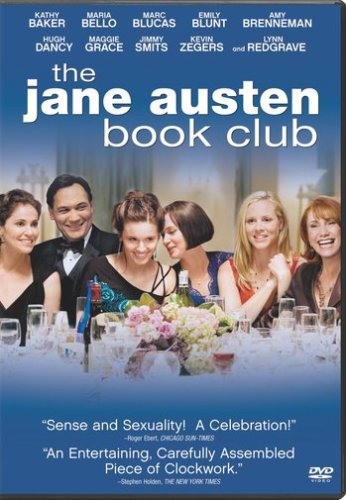
The Jane Austen Book Club DVD directed by Robin Swicord at AmazonIn Drivelry’s continuing mission to convert the obscure into ’scure’,  it is remarkable how some movies do so well at the box office and others do so undeservedly badly.

A great case in point is the film “The Jane Austen Book Club”. Despite the title you really don’t have to know anything about Austen to appreciate this film.

Written and directed by Robin Swicord its dialog sparkles along at a pace that it makes typical action pics look slow. With more layers than wedding cake you could watch it half a dozen times and still not pick up on all the jokes and nuances.

Ok it is a romantic comedy but it’s also a labor of love because behind a lot of the excellent jokes and gags are some serious and subtle points about relationships.

Labelled a ‘chick flick’ any man would enjoy the byplay in this film - there are a raft of muscular characters here and not just Sylvia’s gay daughter Allegra.  It is also full of surprise twists and shocks - you’d defy anyone to come up with anything so true-to-life awful as one of the opening scenes with Daniel and Sylvia in the restaurant.

Great film – terrible box office takings

Four Weddings and a Funeral DVD on Amazon But the thing that is really most shocking about “The Jane Austen Book Club is how such a good film did so relatively badly at the box office taking only $7 million in revenue.

“Four Weddings and a Funeral” (which is a veritable pastiche compared to ”Book Club”) took $245 million….  Even Swicord’s previous film “Little Women” took $50 million.

Narrow it down to Austen literary territory and the comparisons look equally bad:

  • “Bride and Prejudice” took $24 million
  • Keira Knightley’s 2005 “Pride and Prejudice” took $121 million
  • Emma Thomson’s 1995 “Sense and Sensibility” took $134 million
  • and the  recent biopic about Austen herself “Becoming Jane” took $37 million

Perhaps one could argue that Austen fans like their adaptations as close as possible to the original based on the above but it is still interesting to ask why ‘Book Club’ did so comparatively badly (unless you think all of the above are so much better than it is).

What went wrong with this movie?

Here are a couple of guesses which have more to do with marketing than anything else:

  •  why-oh-why did they call it “Jane Austen Book Club”? It’s like holding up a large sign to say “don’t come to this unless you are a) a woman and b) you ‘read’ with a capital R. Well, that’s 3/4ths of the filmgoing population gone then… What about Truths Not Universally Acknowledged? Read My Lips? The Club? Anything would have been better. Was Swicord so shocked when a producer said yes to her pitch (“I have this idea about a film about a book club…”) that she felt she had to stick with it?
  • nobody seems to have really liked Fowler’s book amongst my acquaintances although I appreciate that somebody liked it in order for it to end up on the New York Times’ bestseller list for 13 weeks.  Was the film too closely tied to the Fowler book but actually aimed at a different demographic?
  • did it need a more bankable star – would it have been the same movie with someone else as the female lead Jocelyn? It seems thoroughly unfair to even suggest this as Maria Bello played the role so well but would a Cameron Diaz or Michelle Pfeiffer have had more drawing power?  Would a better known male lead in the place of Hugh Dancy have delivered better box office returns – and again Hugh Dancy played Grigg’s role to perfection so it is unreasonable to suggest this on anything more than marketing grounds.
  • did it need to be rewritten to appeal to a slightly younger audience? As a 16 year old said the other day “it didn’t speak to me” – with it’s acutely drawn portraits of middle age as delineated in the Daniel sub-plot did it just leave a younger audience too much in the cold?

We’ll never know the answer of course but someone should look beyond the box office results above and give Robin Swicord more money to make another film, this time with a better marketing plan.

The only strangely Austen-ish happy ending outcome of all of this was that the film was nominated for the Gladd Media Award and lost to another greatly unappreciated film which Drivelry has also reviewed, Stardust. The co-stars of the two films, Hugh Dancy and Claire Danes, announced their engagement this year.

Posted under Kewl, Reviews, Unanswerable questions

This post was written by mike on August 18, 2009

Tags: ,

Let’s hope the medium is not the message

The video that should have been an article

Lecture video on Flickr by Andrew Feinberg licensed under Creative CommonsWhat motivates people in chosing media types to publish their content? Why, for example, produce a video on a topic which would be far better expressed in print?

How do we benefit from having a talking head pushing their favourite stocks or shares in a video, complete with fleeting verbal references to the  key figures on which the whole argument rests like year-on-year increases in turnover, profits etc?

Is it just that a lot of people secretly fancy themselves in the moviemaking business or, is there some deep dark secret here that accounts for the proliferation of video in a lot of people’s sites?

For instance is it just that:

  • video is harder to copy and host so spammers are less likely to rip off your content?
  • video creates a deeper rapport with your audience?
  • you’re tapping an audience (YouTube?) that you can’t reach in another media?
  • the video is a disguised advertisement for speaking engagements?

Sure video is harder to copy but it’s also a hell of a lot harder for search engines to index… It may well be the case that in 10 years time it will be fully indexable with a speech recognition engine – well if you’ve got a 10 year plan to build an audience that’s great.

If you have the comic timing of Stephen Colbert or the beauty of Angelina Jolie  it may well make sense to produce a video, but if you don’t personally have either of these traits you’re wasting your time.

On the negative side with videos:

  •  you’ve got to be running sound (perhaps in an open plan office) to watch a video,
  • there is no way that your viewer can quickly skip to the bits that interest them (so the first time you’ve lost their attention you’ve lost them totally as they hit the stop button) and
  • you require their full attention e.g. they can’t be listening to music as they watch.

Why is it that people don’t get podcasting?

Creative Zen MP3 player by blogefl on Flickr licensed under Creative CommonsIn 2005 the hype that currently is devoted to apps like Twitter or Facebook was all about the new medium of podcasting,  hype that Drivelry signed up for at the time.

In contrast to video this really does seem to be a publishing medium that makes sense for a lot of content.

Yet very little onscreen commentary acreage is devoted to podcasting these days, and the growth of podcasting has been relatively slow with about 12% of people interviewed by the Pew research study having listened to podcasts in 2006, and 19% listening when Pew re-ran the study in 2008.

All up a very pedestrian 7% growth in podcasting usage in the 2 years (presumably Pew is unlikely to rerun the survey till 2010 albeit newer July 2009 figures suggest that growth might be accelerating somewhat).

In a sense it’s a testament to the power of advertising. As in ‘podcasts are free so there’s little incentive to push them’

You can identify popular podcasts on iTunes but it will default to popular podcasts for your country (using automatic IP address location) rather than globally, thereby undermining one of the principle benefits of podcasts: that they enable you to listen to the best radio in the world at the time of your choosing, with the most recent episodes collected for you automatically.

Podcasts make sense as a publishing medium because they enable you to:

  • target otherwise unused audience time (for instance when you are driving or on public transport)
  • they do not require your full attention (you can cook or clean whilst listening)
  • they take advantage of radio’s traditional ability to build rapport

In theory you can monetize them by using a system such as Wizzard’s.

There are absolutely superb podcasts out there from organisations like NPR, the BBC and assorted smaller producers that mean you should never have to listen to a boring radio program again (you can find a few of  Drivelry’s favourite podcasts here  if you want a random playlist you can import into iTunes).

If you know why podcasts are so under-appreciated hit the comments box below and tell us why!

Twitter as a publishing medium

It’s impossible to consider the appropriateness of publishing technology without mentioning Twitter. Photo of Twitter screens on Flickr by glenn.batuyong licensed under Creative Commons

It’s not that SMS’ing is a bad concept (think of the positives for a whole younger generation who now have to be functionally literate to socially interact) but with Twitter we have a publishing medium where the length of your story at 140 characters is dictated by a technology launched 17 years ago.  If Douglas Adams was still alive today it would form a key joke to build a novel around. 

There is not a frequent Twitter user out there who hasn’t spent hours of aggregated time trying to work out how to compress something meaningful into 140 characters and then hoping that the mishmash of bad spelling and abbrevations can actually be understood by the recipients.  And yet the constraint is also useless because anyone with any Twitter volume (Following say 20+ people) is unlikely to have it routed to their mobile phone by SMS lest they be drowned in low value messages.

Twitter’s principal claim to fame (that you can build two-way interactions with complete strangers you couldn’t otherwise reach by Following and Tweeting them) rings hollow when you’re talking about a recipient who is Following even 50 or so people. In practice they are likely to have a list of  Favourite Twitterers and use something like Tweetdeck to filter out those people’s Tweet’s into a Group, thereby insuring that they rarely see Tweets outside that Group. 

Without this sort of grouping  the volume of messages would again be unmanageable by anyone with any constraints on their time – drowned in updates from people noting who they’ve just had a beer with, or that they’ve just landed at LAX.

Twitter is therefore unlikely to become a meaningful substitute for more proprietary instant messaging clients like Skype.

As with any new medium (Twitter started in 2006) there’s no question that what was initially a more focused medium is being increasingly targeted by spammers and direct marketers of all shades and to add insult to injury if you use Twitter to inform readers about new articles (say blog posts) you are probably losing ad revenue as well.

There is no question that the Twitter audience is growing at the moment so if you’re a ‘momentum publisher’ it may be the place to be it’s also evident that it’s underlying structural problems could cause it to plateau equally rapidly.

Social media interaction & publishing

Amongst the cheerleading that is going on about social media participation generally it also pays to realize that you are basically building up someone else’s content for them. Great proposition really:

“Hey! How about you spend your time writing a whole bunch of stuff for me on my website so that I can insert ads around it and make money from you and others clicking on the ads? Sign here ….”

Want your own website to rank well for the phrase ‘forestry products’ ?

Well if you create a lot of content in a prominent social media site it is more than likely that the search engines are going to rank that site higher than your own… Even better, most of the time you will find that ’No Follow’ tags are automatically inserted around any link pointing back to your own site that you place on the social media site, thereby insuring that you get no PageRank benefits from doing this.

So social media participation may be important but it’s also important to understand where you could be shooting yourself in the foot…

Posted under Unanswerable questions

This post was written by mike on July 28, 2009

Tags: ,

How much damage can Twitter do to Google & bloggers?

Photo by carrotcreative from Flickr licensed under Creative Commons
An interesting article from Danny Sullivan at SearchEngineLand this week on tracking traffic into his website via Twitter.

In a nutshell (and he’d probably be horrified to see it oversimplified like this) he was pointing out that for one of his articles only about a sixth of the traffic it actually got from Twitter showed up in Google Analytics.

The thing that really struck me was not so much the problem with Google Analytics but more what the implications might be for Google’s revenue and control over the search engine space.

Why? Well Danny’s suggested explanation for this missing traffic was that a lot of Twitterers use Twitter applications under Microsoft Windows or on mobile devices that don’t support javascript (Google Analytics tracks visitors to your website using javascript).

Twitter means less advertising revenue for Google’s Adsense product

However more importantly to Google’s revenue,  javascript is what Google uses to embed text ads in many websites (with a normal browser that supports javascript you’ll see ads in this page)  where the website participates in Google’s Adsense program.

No javascript (because someone looking at your website or blog coming from a link posted in Twitter is using some Twitter application that doesn’t support it) means no ads.

No ads means no revenue for Google or the blog owner.

How significant a problem are Twitter applications in this regard for Google and bloggers?

It’s hard to say at the moment. Danny was just looking at one article but the implication might be that up to 5/6ths of readers might not be seeing Google Adsense ads.

On a B2B site I consult for they receive a few million page impressions a year but within a few months of implementing a Twitter feed we now find that Twitter is the 7th largest referrer of readers to the site.

Imagine the revenue loss to this site if it turned out that only 1/6th of the actual Twitter users of this site were seeing our ads?

Yep, bloggers who thought Twitter was their friend would turn out to be wrong.

For Google it’s not the end of the world as  9/10ths of their revenue comes from direct search advertising (where they don’t have to share that revenue with any grubby bloggers).  However  the development and increasing popularity of applications that bypass javascript to view pages could be a threat and compete with their own browser Chrome, and Twitter’s willingness to let Google index the Twitter stream in real time could also be a problem (if there’s a better Twitter search engine because Twitter creates it or gives a 3rd party privileged access then Google is ‘on the outer’ when it comes to search ad  revenue from Twitter).

Perhaps the rumours earlier this year about a Twitter acquisition by Google might even get a second run? (-:

Posted under Unanswerable questions

This post was written by mike on June 26, 2009

Tags: , , ,

What is the new socially aspirational career?

Five years or so ago it was all so simple.

We had moved on from the doctor and lawyer aspirations that our parents had for us as children to lionize careers in banking and finance, but now bankers and financiers are lying gasping on the floor and the coroner is on the way.Photo by carveconsulting from Flickr licensed under Creative Commons

Stockbrokers and equity analysts who used to be badgered for hot tips at cocktail parties don’t get invited because their social circle got burnt listening to them.

Hedge fund managers are regarded as Ponzi scheme promoters.

Marketeers (rhymes with ’musketeer’) are just trying to get us further into debt buying stuff we don’t need.

HR managers … hmm:

“Come right in, look there’s no easy way to say this but we’ve decided to make your position redundant.”

Doctors (well at least GPs anyway) in countries like the UK and Australia are merely badly paid public servants (with the current US adminstration aiming to head the same way).

Computing people after 2001 are merely car mechanics that got too big for their boots during the dotcom boom with no communication skills to ‘boot’.

The most popular area in the legal world these days is of course insolvency and litigation (taking people’s homes away from them and the stuff you do prior to taking people’s homes away from them).

Perhaps boilermakers are going to come back (I was never exactly sure what they did anyway)? What about bartenders – somebody has to mix the drinks for people to cry into?

Personally my plan is to further develop the field of blogotherapy. With 47 million of them out there it has to represent rich pickings. Workshop details to be posted shortly.

Posted under Unanswerable questions

This post was written by mike on June 4, 2009

Tags: , ,

Anonymous online? Facebook, Blogs and Generation Y

Photo by sklathill - licensed under Creative Commons We all like to think of ourselves as plugged into the zeitgeist. The web? Was there in ‘95. LinkedIn profile? Got one years ago? Skype? Tick. Blog? Tick (you’re looking at it). SecondLife? I’m there. 24 x 7 online gadgets? Got them in spades.

However, I have to confess to at least one embarassing form of personal failure up there with sexual inadequacy, I don’t have a Facebook account.

Why? At base, it comes down to a liking for anonymity. Surely one of the most wonderful things about the web when it first came about was the sense of freedom: you could write whatever you wanted and be whomever you wanted to be. Facebook, Myspace, and some other forms of social media are the very antithesis of this. It’s about setting down a version of yourself in stone. Forget re-invention, it’s about demonstrating how popular you are by the number of ‘Friends’ you have and creating a spider’s web of links that to me are something to be trapped in.

My generation Y late 20-something sister doesn’t understand my squeamishness about Facebook.

She doesn’t understand why I don’t like her posting photos of my small children in Facebook, “after all people have to be my Friends to see them” (well they aint necessarily my friends). And if she has got to grips with Facebook’s labyrinth of privacy settings it sure seems to be the case that other people (including the New York Times) haven’t.  And that’s before I mention my friend whose girlfriend was signficantly underwhelmed to see him in a photo that had been tagged with his name on Facebook in a nightclub in closer embrace than his girlfriend thought was proper with another girl.

It doesn’t matter whether only your Friends can see your pictures and other content. We’ve got to remember that this is the digital age and anything once digital is w-a-y more transmissible than it ever was before. Just ask the copyright owners of digital music. All it takes is a right-click and copy and it’s out of your hands!  It’s not that I object to all forms of digital recording, for example I routinely record my Skype conference calls for work as the easiest form of note taking there is, and have been told off for doing so by colleagues, but I don’t post these on the web!

As more and more websites open themselves to the all-seeing scrutiny of the Googlebot we need to realize that your online footprints don’t  just stop with text. We are not far away IMHO from ’similar image’ search where for example you can put in a photo of a friend and have the search engine find digitally similar images wherever they are. Check out, for example, the GoogleLabs ‘Similar images’ project, or for that matter the image technology that will recognise photos of your aunt once you’ve tagged her in Picasa. Sure you can get Google in some cases to remove something but typically only with regard to a site  that you control. And even once removed we have things like Alexa’s ‘Wayback’ machine to show us pages as they were BEFORE they were deleted.

My own children are going to be exposed to totally different forms of bullying at school, someone who doesn’t like them taking a nude photo in the lockeroom using the camera in their phone and putting it up on the web (and if they have a reasonable understanding of search engine optimization knowing enough to use the name of my kid in some anchor text pointing at the link to improve it’s PageRank on Google) AKA ’sexting’.

And call me paranoid but I wonder how many people on Facebook realize that it provides  a great resource for hackers following social engineering strategies? How many people out there have passwords which are the name of the dog or their children or spouse? And that’s before we get into the issue of people using the same password on different accounts (by various reports over half of us do this). If I make a phone call to your parents at your house how much can I find out by name-dropping a few names of your friends?

I realize that Facebook provides an easy way to keep in touch with a large bunch of scattered friends but most Facebook related studies show that in fact no matter how many ‘Friends’ we have we really only actively communicate with a small number. Why not simply email your friends an electronic Christmas card once a year with what you’re doing? You don’t have to be a genius to use Word and Outlook in a mail merge.

And for work who on earth would want their Facebook profile to come up in Google before say their business related information from their company website, or their LinkedIn profile?

I realize that all of the above may just label me (correctly) as Generation X (those born between ‘61 and ‘81). Perhaps it really is the case that I’m just too uptight and lack the perspective of a post-1980 digital native as expressed in ‘Born Digital’ by John Palfrey and Urs Gasser.  On the other hand maybe a lot of those digital natives are just young people like there have always been young people, who do not fully comprehend the impacts of what they’re doing online, and will only do so in about 20 years time.

 PS. It was pointed out to me that my whole argument is well and truly undercut by having a blog. Well, yes and no. My blog is hosted using the ‘Domains by Proxy’ service so that you cannot directly query the details on the domain owner. It’s not failsafe, there are a number of ways you could really track down who I am, but as per the above paragraphs if I it would be ruinous for me to have my identity made more public than it is then I need to still be a little bit careful about what I write on the blog.  A lot easier way to do it is to just set up a blog on something like WordPress.com using a Hotmail account!

Posted under Hate pets, Unanswerable questions

This post was written by mike on May 10, 2009

Tags: , ,